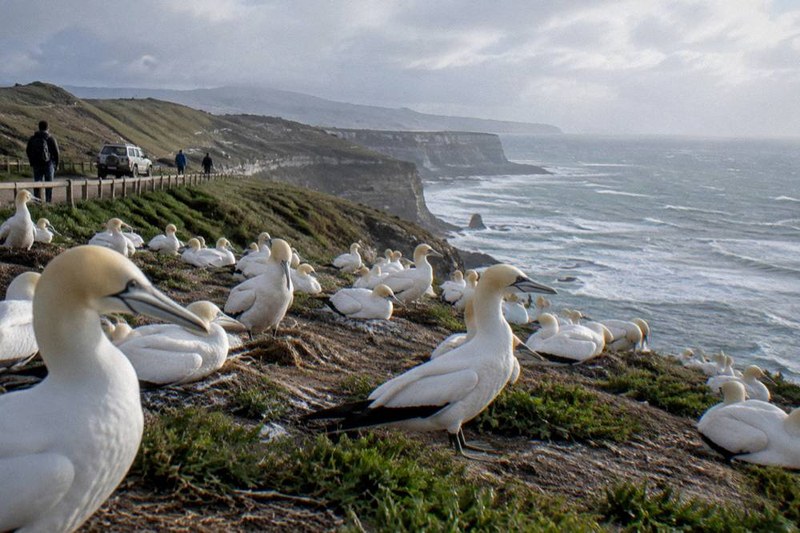
Gannet Colony Near Napier: Where It Is And How To Visit
The gannet colony near Napier sits on the cliffs of Cape Kidnappers, about 25 minutes by road from the city, and the easiest way in for most visitors is a guided overland tour across the working farm above the cape.
Short answer
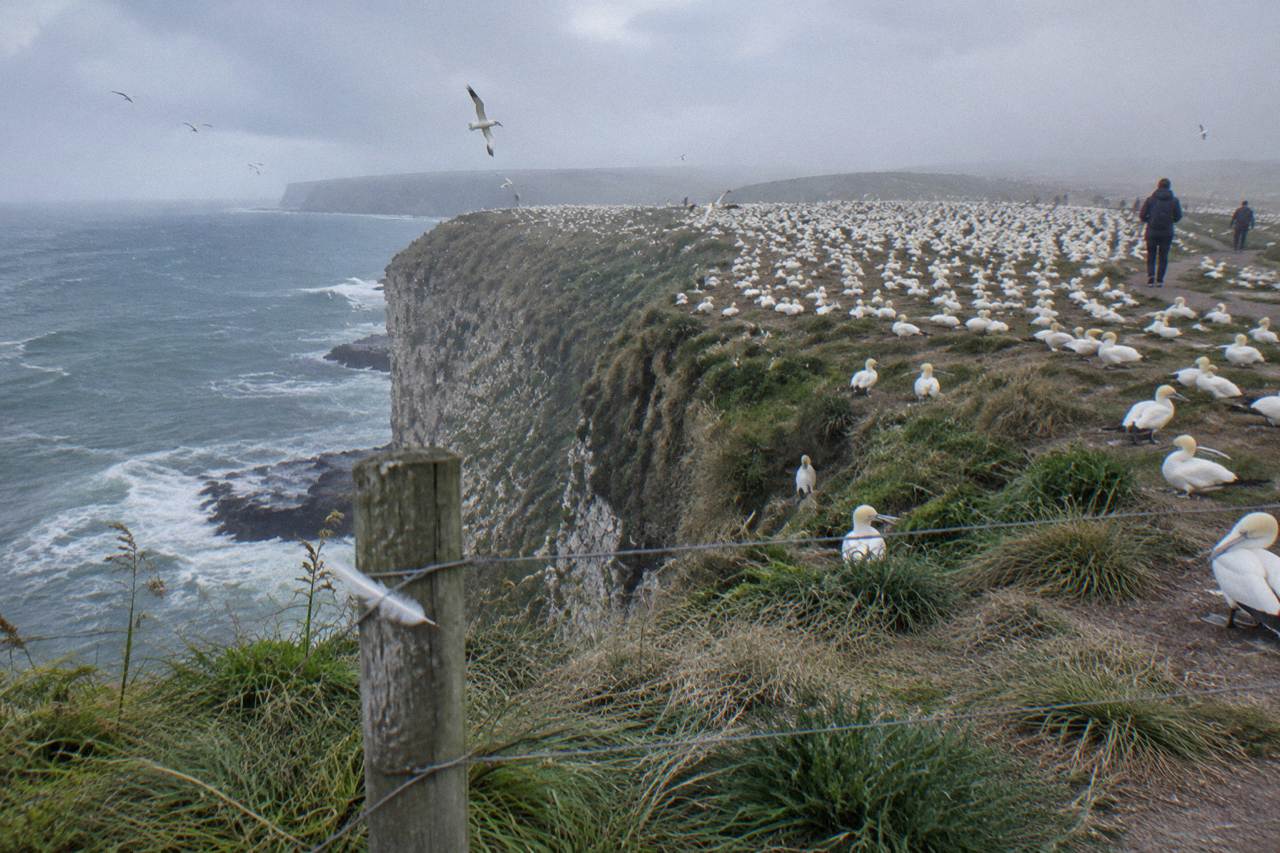
The gannet colony is at Cape Kidnappers, 21 km south of Napier at the end of Clifton Road, Te Awanga. DOC puts it at 6,500 pairs, the largest and most accessible mainland colony in the world. The plateau colony is on private land, reached by overland tour; the free beach walk is 19 km return and tide-dependent.
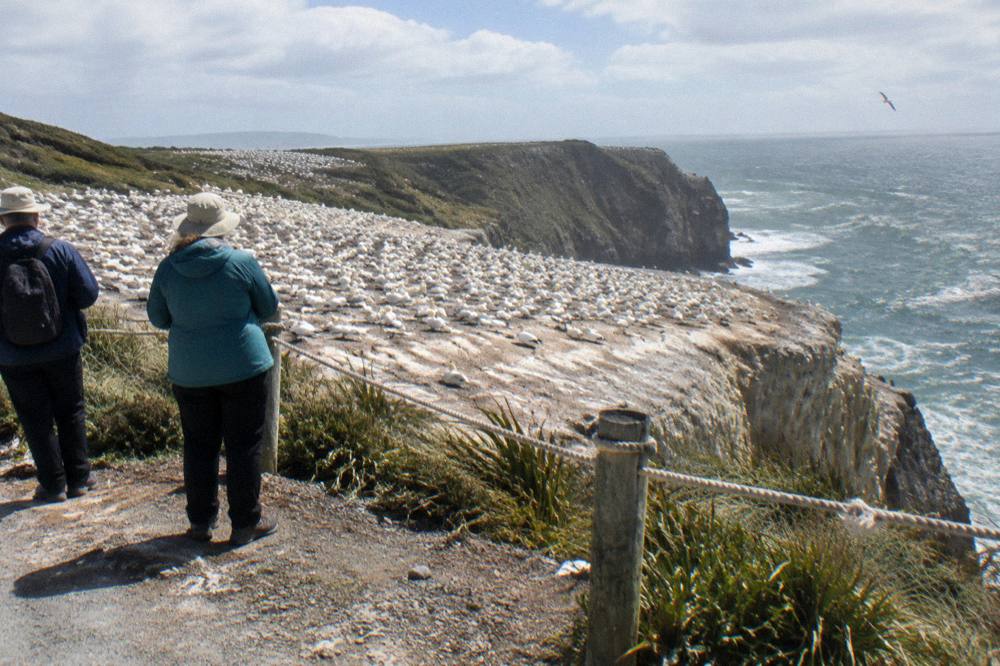
DOC puts the colony at 6,500 pairs of Australasian gannets spread across the cliffs of Cape Kidnappers, and calls it the largest and most accessible mainland gannetry in the world. The birds have nested at the cape since the 1870s, and today the site splits into separate nesting areas: Black Reef, closest to the walking access, and the Plateau colony on private land above the cliffs, which DOC describes as the best place to view nesting gannets.
Getting there is the part most visitors underestimate. The colony is not beside a car park. It sits at the end of a working farm track above the coast, and the practical choices are a guided overland tour in a 4WD vehicle, a long tide-dependent beach walk, or, for independent riders, a self-guided fat-bike trip. This guide covers where the colony sits, how far it is from Napier, what each way of visiting involves, and what it costs, drawing on tour and DOC figures. If you want the short version before the detail, the Napier gannet tour overview covers the operator's full range of options in one place.
Where Is The Gannet Colony Near Napier?
The gannet colony is at Cape Kidnappers, the headland at the southern end of Hawke Bay, 21 km south of Napier and 18 km east of Hastings. The nesting areas sit on and below the clifftops: Black Reef is the first nesting site, 7.5 km along the beach from Clifton, and the Plateau colony, which DOC calls the best viewing spot, is on private land above the cliffs, reached overland through Cape Kidnappers Station.
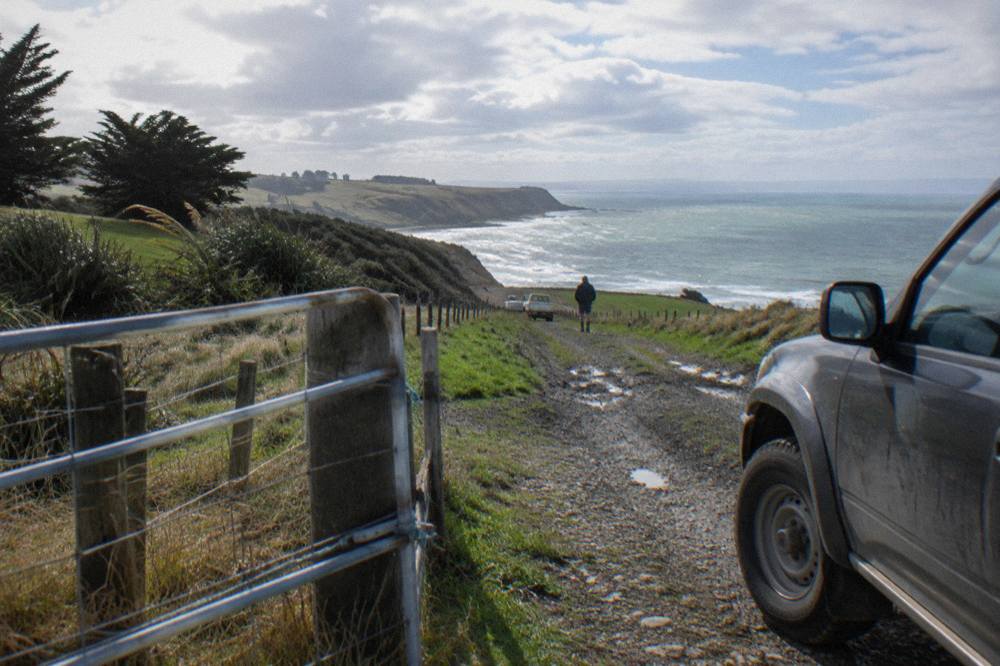
Cape Kidnappers is a DOC reserve, Te Kauwae-a-Maui Gannet Reserve, but the geography matters more than the name. The reserve is not one open clifftop with a viewpoint. It is a chain of nesting sites along rugged coastline, and the best of them, the Plateau colony, sits inside a privately owned nature reserve on roughly 2,500 hectares of working farmland with a predator-proof fenced conservation area. That is why a fence line and a farm track, not a public car park, stand between the road end and the birds.
The name itself is older than the reserve. The gannets came later in the story: birds began nesting at the cape in the 1870s, and numbers have grown steadily since to the 6,500 pairs DOC counts today.
For a visitor in Napier, the practical anchor point is Clifton, the small settlement at the end of Clifton Road past Te Awanga. The beach walk starts at Clifton, Scotmans Point, and the overland tour operator's base sits at 396 Clifton Road, about a 25 minute drive from central Napier, with a similar drive time from Hastings and Havelock North. From either start point, the colony itself is still several kilometres away: 7.5 km of beach to Black Reef on foot, or a 4WD ride across the farm and native bush to the plateau above.
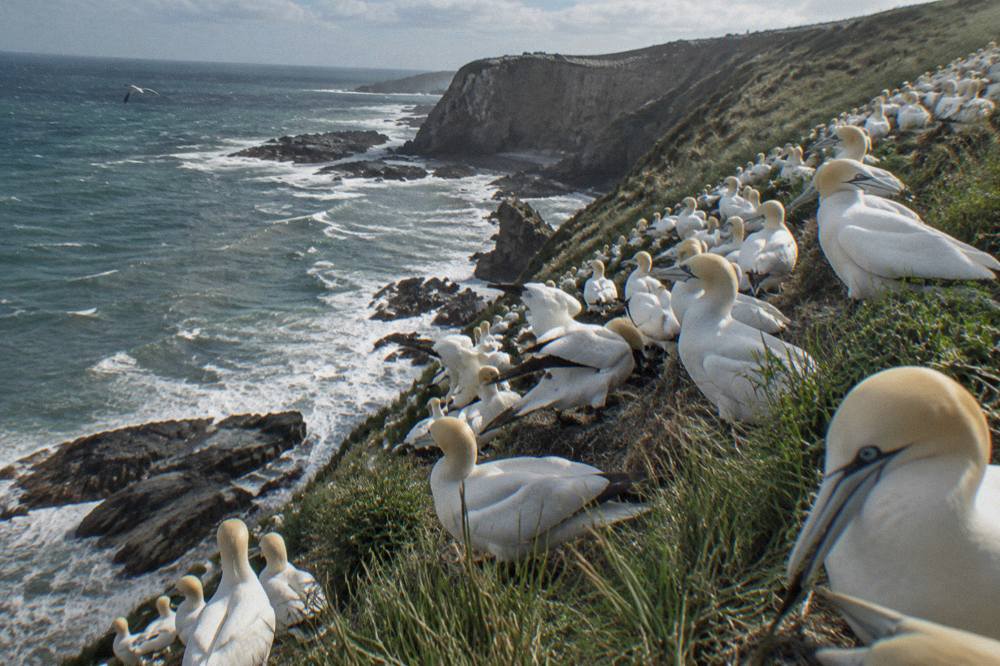
The colony is genuinely worth the effort of understanding the layout. Australasian gannets are large birds, with a wingspan of about 1.8 m, and they nest densely, single eggs incubated on the parents' webbed feet, pairs that stay together over many seasons. Standing at the barriers at the plateau, with the noise and the smell and the birds wheeling past at eye level, is a different order of experience from watching seabirds from a boat deck. DOC asks visitors to keep behind barriers or at least five metres from nesting gannets, and nesting birds dislike loud noises and fast movement.
How Far Is The Gannet Colony From Napier?
The drive from Napier to Clifton and the tour base at Te Awanga takes about 25 minutes, roughly 21 km south of the city. The colony itself is a further 7.5 km along the coast from the Clifton beach end if you walk, or a shorter distance overland by farm track. Hawke's Bay Airport serves Napier, and the base car park has room for several motorhomes.
Distances here come in two stages, and conflating them causes most of the confusion. Stage one is Napier to the road end: about 25 minutes by road to Clifton, the same from Hastings and Havelock North, along the coast through Te Awanga.
- Standard Overland Gannet Tours$55
- Cruise Shore Excursions$93
- Private And Sunrise Tours$604 per group
Stage two is the road end to the birds, and that is where the modes diverge. On foot, the beach walk to Black Reef, the first nesting site, is 7.5 km each way, and DOC grades the full route 19 km return, telling walkers to allow at least 5 hours for a comfortable return trip. A steep, rough, muddy climb of about 1 km leads on from Black Reef toward the second colony. By vehicle, the overland route crosses private farmland and native bush to the nature reserve above the cliffs, and the operator says these tours are not governed by the tides because they travel above the cliff tops.
| Leg | Distance or time | Mode |
|---|---|---|
| Napier to Clifton / Te Awanga | About 25 minutes by road | Car, campervan or tour coach |
| Hastings to Clifton | About 25 minutes by road | Car or tour coach |
| Havelock North to Clifton | About 25 minutes by road | Car or tour coach |
| Clifton to Black Reef | 7.5 km each way | On foot along the beach |
| Full beach walk | 19 km return, at least 5 hours | On foot, tide-dependent |
| Clifton to the Plateau colony | Farm track across private land | 4WD overland tour |
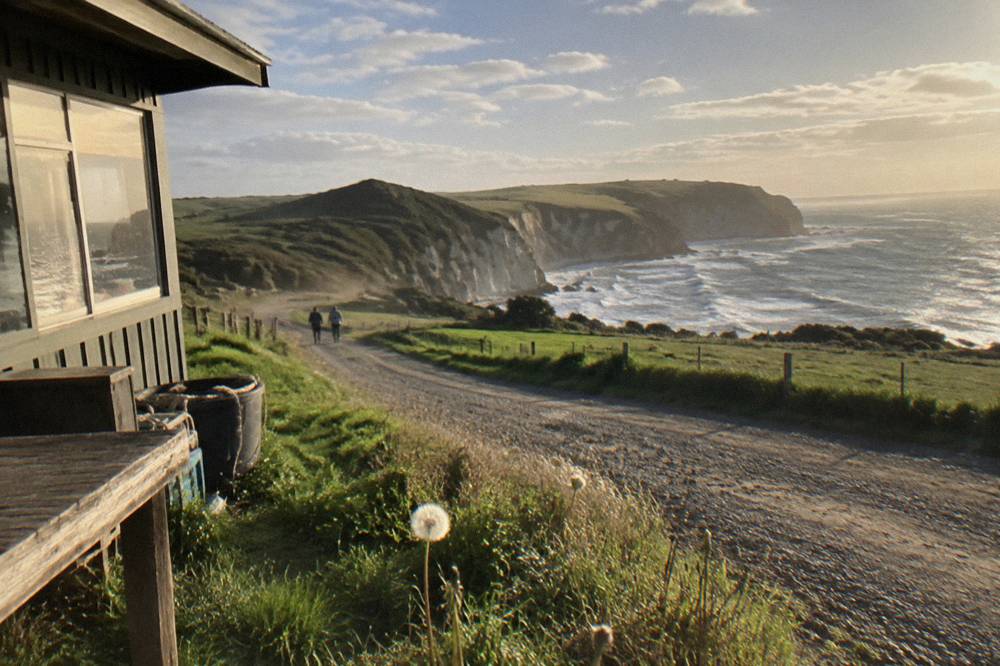
One recent change matters to anyone driving themselves: Clifton Motor Camp closed on 20 February 2026 after a geotechnical assessment found unstable land above it, was permanently closed in July 2026, and in August 2026 Hastings District Council voted to close a section of Clifton Road to vehicles at the former campground. Pedestrian access to Clifton Beach and the walking route stays open. This affects walkers and bike riders, not the overland tours, whose base is at 396 Clifton Road.
For cruise passengers the distance question has its own answer, covered in full later in this guide, because the port sits right in Napier and the shore excursion meeting point is on Marine Parade rather than out at Clifton. For everyone else, the summary is that the colony is close to Napier by road and far from anywhere by foot, which is exactly why the guided options exist. The general how to get to Cape Kidnappers guide breaks down the drive, the parking and the road conditions in more detail.
What Is The Easiest Guided Way To Reach The Colony?
For most visitors the easiest way in is the 3-hour overland gannet tour, from $56.23 per person meeting at the operator's base at 396 Clifton Road, rated 4.9 across 1,052 reviews. A twin version runs from $55.00 per person, rated 4.8 across 378 reviews, and meets at 396 Clifton Road, Te Awanga. Both cross the farm by air-conditioned vehicle to a flat plateau with bench seats, and little or no walking is required.
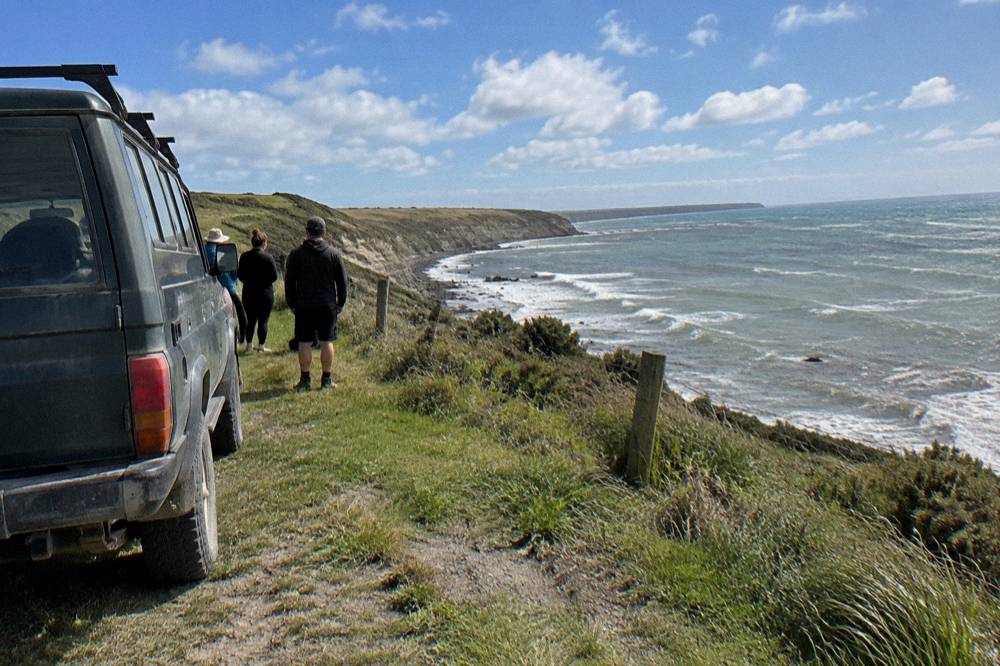
The two standard overland tours differ in one main respect: how you get to the start. The 3-hour tour meeting at the base has you drive yourself to Te Awanga, where a large off-road car park has room for several motorhomes and good bathroom facilities, which matter because there are no toilets on the tour itself. The 3-hour Lowest Price tour meets at the operator base in Te Awanga rather than your Napier accommodation, from $55.00 per person, with light refreshments on board. Hotel pickup on the first version is an optional add-on chosen at booking.
Both are 3 hours in total, and both spend their time on the same overland route: a ride across a working farm and native bush to the privately owned nature reserve above the cliffs. The operator describes the plateau as flat ground with bench seats, says walking there is safe and easy, and notes that everything can also be seen from the vehicle without getting out. The only physical requirement is being able to get on and off the vehicle unaided. Tea, coffee and a biscuit are served at the colony. Dogs are not allowed, as the site is a wildlife sanctuary and a DOC reserve.
Beyond the standard options, the same operator runs private and sunrise versions for visitors who want the vehicle to themselves. The Private 4-Hour Tour runs from $704.30 per group for up to 4 people, 4 hours with 45 minutes at the colony per itinerary, coffee or tea included, and free cancellation up to 24 hours before start. A Private Sunrise version runs 3 hours from $636.15 per group of up to 4, with a gourmet breakfast of pastries, fresh fruit and yoghurt, plunger coffee and juice. Both are priced per group, not per person, so they make sense for four travellers splitting the fare rather than two.
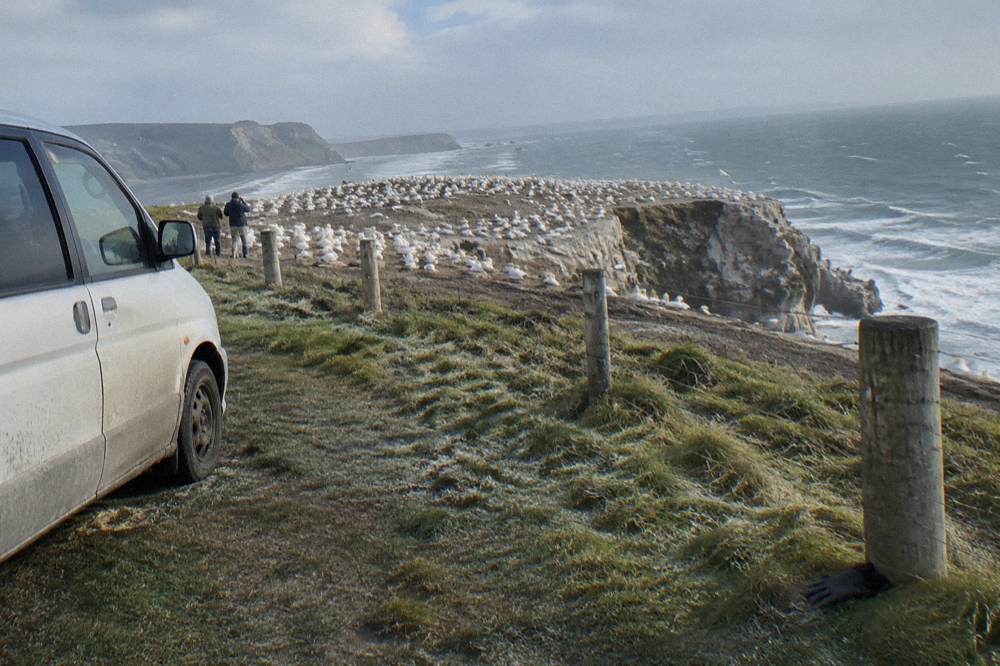
For help choosing between the standard and private formats, the standard or private Cape Kidnappers tour comparison walks through the price-per-person maths and who each version suits. The short answer: solo travellers, couples and small groups on a budget do fine on the standard tours; families or photographers who want the vehicle and the schedule to themselves pay the group rate.
Can You Walk To The Gannet Colony From Clifton?
Yes, but it is a serious walk: 19 km return along the beach, graded Expert by DOC, with at least 5 hours advised. The walk is possible only around low tide, high tides and big seas block the beach, and you must leave the Cape no later than 1.5 hours after low tide. Black Reef, the first nesting site, is 7.5 km from Clifton.
The walk is free and it is spectacular, and DOC is blunt about what it demands. The route runs along the beach beneath cliffs, about 7 km of which lie under cliffs subject to significant landslide and rockfall. A landslide seriously injured two tourists in January 2019, and another large landslide in February 2020 closed the beach before the track reopened. DOC reports three serious injury landslide events in the past 50 years and large landslides every year, and says the status of the track can change at any time, so check the safety alert on the DOC page and the signage at Clifton before setting out.
The tide is not a suggestion, it is the governing condition. The beach walk is possible only around low tide, high tides and big seas block the beach, and walkers must leave the Cape no later than 1.5 hours after low tide. Check the tide table before going. The dedicated Cape Kidnappers tide times guide covers how to read the tables and plan a departure window, and the can you walk to the gannet colony post answers the access question in detail.
| Walking fact | Figure | Source note |
|---|---|---|
| Route distance | 19 km return | DOC |
| Grade | Expert | DOC |
| Time advised | At least 5 hours | DOC, for a comfortable return walk |
| First nesting site | Black Reef, 7.5 km from Clifton | DOC |
| Climb to second colony | About 1 km, steep, rough and muddy | DOC |
| Hazard zone | About 7 km of beach under landslide-prone cliffs | DOC |
Two seasonal closures shape the walking calendar. The track from the beach to the plateau gannet colony is closed from July to the week before Labour Weekend each year to limit disturbance to returning birds, and the guided tours themselves run only from 1 August to 30 April. DOC's kit list for the walk is a good gauge of its seriousness: sturdy footwear, food and water, sunscreen and hats, extra clothing for cool sea breezes, a water and windproof jacket, gloves, a head torch, and a communication device. There is a DOC rest shelter with toilets a short way up the track from the beach end, with no drinking water. The area is susceptible to tsunami; if a siren or alert sounds, move to higher ground.
Riders have a third option: a self-guided fat-bike ride from 475 Clifton Road, 3.5 to 4 hours in total, needing at least intermediate fitness, with bike, helmet, spare tube, pump and map supplied and a short walk to the plateau colony at the end. A separate tide-dependent tractor-trailer ride along the beach from Clifton also exists, run by a different operator; check its own site for whether and when it runs. Neither is a guided overland tour, and neither escapes the tides.
When Is The Best Time Of Year To See The Gannets?
Tours run from 1 August to 30 April, and DOC says the best viewing is early November to late February. Adults return to the cape from around July for courtship and nest building. Gannets lay a single egg, both parents incubate it on their webbed feet, and fledglings fly to Australia and typically return in their third year.
The calendar at Cape Kidnappers follows the birds, not the school holidays. Adults return from around July, which is why the track closure to the plateau runs through that month and why the tours start on 1 August. Lifespan runs 25 to 40 years, and pairs stay together over many seasons. The wider set of guides lives on Napier Gannet Tour.
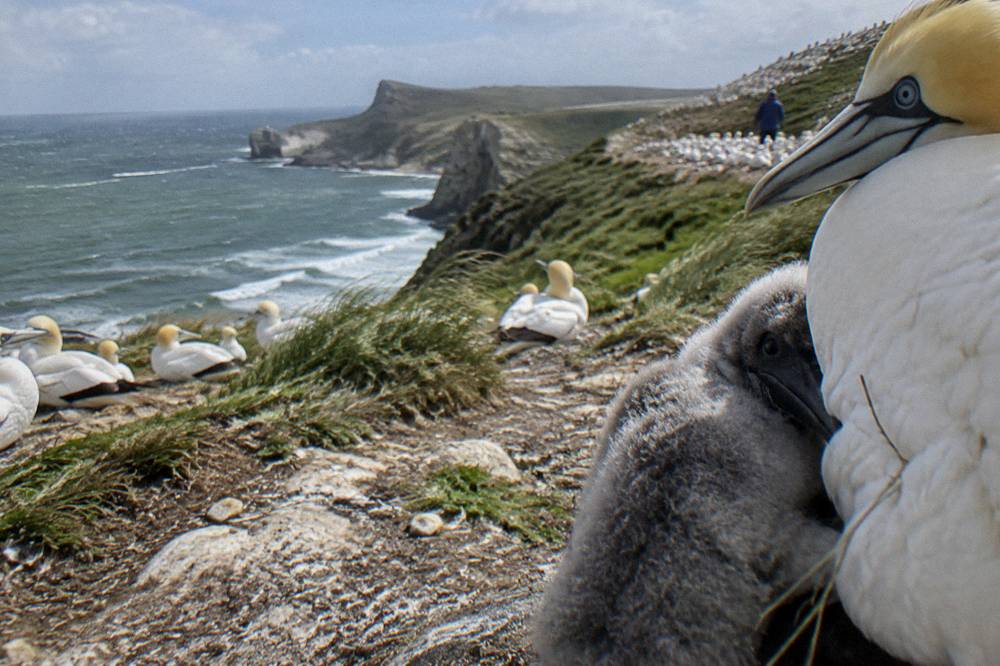
For planning, the practical windows are these. Early November to late February is DOC's stated best viewing period for the colony. The full breakdown, including what the birds are doing in each month, is in the Cape Kidnappers gannet season guide.
Weather is its own variable, and the coast can be windy, cool and changeable even in summer. One 3-hour tour advises a jacket, and that is sound advice for any month. No operator can promise weather, a sighting, a bird count or a chick stage on a given day; departures can be cancelled or rescheduled, and the overland tour's advantage is simply that it does not depend on the tide. The Cape Kidnappers weather guide covers what to expect by season.
What Will You Actually See At The Plateau Colony?
DOC puts the colony at 6,500 pairs of Australasian gannets, the largest and most accessible mainland colony in the world, and describes the Plateau colony as the best place to view nesting gannets. Close-up views are possible at the Plateau and Black Reef colonies. Other birds at the cape include white-fronted terns, variable oystercatchers, reef herons, Caspian terns and little blue penguins.
A gannetry is a sensory event before it is a visual one. The birds nest shoulder to shoulder, pairs renovating nests, greeting each other with fencing bill displays, diving offshore in successive waves. With a wingspan of about 1.8 m, an adult gannet passing at eye level along the cliff edge is a large animal at close range, and the plateau's bench seating puts you level with the colony rather than above it. DOC asks visitors to keep behind barriers or at least five metres from nesting gannets, and to move calmly; nesting birds dislike loud noises and fast movement.
The reserve rules protect that density. No dogs or horses, no motorbikes or vehicles off the beach into the reserve, no fires or camping, keep to the track through private land, and drones on conservation land need a DOC permit. These are not bureaucratic niceties at a site where the birds' breeding success depends on minimal disturbance, and the track closure from July to the week before Labour Weekend exists for exactly that reason.
Photographers should plan for the light as much as the birds: the colony faces the open Pacific, morning and late-afternoon angles flatter white plumage against dark water, and a longer lens lets you crop tight behaviour shots without leaning over the barriers. The Cape Kidnappers gannet photography guide covers gear, angles and etiquette in depth.
How Much Do Gannet Colony Tours From Napier Cost?
Cheapest is the 3-hour tour from $55.00 per person, rated 4.8 across 378 reviews; it meets at 396 Clifton Road, Te Awanga, and there is no pickup, so passengers arrange their own transport to the base. The Meet at Base version from $56.23 per person, rated 4.9 across 1,052 reviews, adds hotel pickup as an optional booking extra. Private tours are priced per group of up to 4, from $604.00 to $704.30, and the 7.5-hour winery combo runs from $1,214.00 per group of up to 2.
Every figure below is a USD "from" price on the stated basis, per person or per group, exactly as the booking pages show them. Private tours are per group, so never compare their headline number with a per-person fare without saying so. All the tours listed carry free cancellation up to 24 hours before start.
| Tour | Basis | From price | Duration | Reviews |
|---|---|---|---|---|
| 3-Hour Tour, Lowest Price | Per person | $55.00 | 3 hours | 4.8 across 378 reviews |
| 3-Hour Tour, Meet at Base | Per person | $56.23 | 3 hours | 4.9 across 1,052 reviews |
| 4WD Safari Vehicle, 4 Hours | Per person | $93.00 | 4 hours | Not yet reviewed |
| 4-Hour Shore Excursion, 45-Minute Stop | Per person | $95.42 | 4 hours | 10 reviews |
| 3-Hour Sunrise, Pickup Included | Per group (up to 4) | $604.00 | 3 hours | 3 reviews |
| 3-Hour Sunrise Tour | Per group (up to 4) | $636.15 | 3 hours | Not yet reviewed |
| Private 4-Hour, Pickup Included | Per group (up to 4) | $688.00 | 4 hours | 4 reviews |
| Private 4-Hour Tour | Per group (up to 4) | $704.30 | 4 hours | 11 reviews |
| Private 7.5-Hour Winery Combo | Per group (up to 2) | $1,214.00 | 7.5 hours | Not yet reviewed |
The value logic is straightforward once the basis is clear. A party of four on the base-meeting standard tour pays four per-person fares at the from price, while the same four on the Private 4-Hour Tour pay from $704.30 for the vehicle to themselves, a longer itinerary and 45 minutes at the colony per the itinerary. Couples and solo travellers are firmly in standard-tour territory. The Cape Kidnappers gannet tour price guide works through the arithmetic of every option, and the how much does the gannet tour cost compared to walking post sets the fares against the free but demanding beach walk.
At the top of the range, the Private 7.5-Hour Winery Combo pairs the gannet visit with Hawke's Bay wine country in one day, pickup from your accommodation from about 8:30 am and back by 4:00 pm, in a luxury Range Rover, from $1,214.00 per group of up to 2. It is a different product from a colony trip, and it is priced accordingly.
Which Tour Suits Cruise Passengers Visiting Napier?
Only the two shore excursions are built for cruise passengers: a 4-hour excursion from $95.42 per person with 45 minutes at the colony, and a 4-hour 4WD safari version from $93.00 per person. The standard 3-hour tours are not for cruise passengers. One shore excursion meets at 100 Marine Parade, opposite the Napier Museum; the other meets at the pink flag by the Sound Shell, beside the i-SITE where the port shuttle drops.
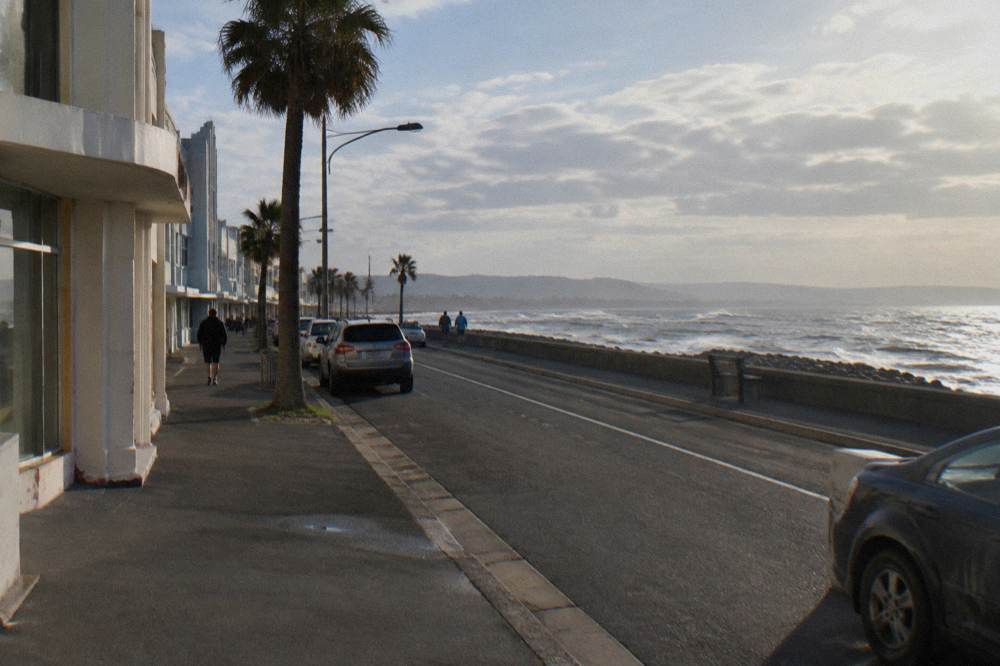
Cruise logistics in Napier have a specific shape. Ships visit from October to April. Passengers can walk down the gangway onto the wharf but cannot walk out of the port; a shuttle runs to two stops, the Napier i-SITE at 100 Marine Parade and the National Aquarium of New Zealand, and taxis cannot enter the port. The return shuttle leaves from the i-SITE. That geography makes the Marine Parade meeting point, 200 m from the shuttle drop, the natural start for a shore excursion, and it is why the shore versions of the gannet tour exist separately from the standard ones.
The two shore options differ in vehicle and structure. The 4-Hour Shore Excursion runs from $95.42 per person, travels by air-conditioned vehicle, and includes 45 minutes at the colony per the itinerary plus coffee or tea. The 4WD Safari Vehicle version runs from $93.00 per person, about 25 minutes each way by coach from Napier, with hot drinks, coffee or tea. On some ship days the operator collects passengers directly from the port because of short port times, and departure times are set per ship.
Before booking anything, check your ship's all-aboard time against the tour's 4-hour length, and remember the free cancellation window runs to 24 hours before start. The deeper dive on schedules, shuttle stops and port-day timing is the Napier shore excursion gannets guide.
What Else Should You Know Before Visiting The Colony?
Tours run 1 August to 30 April including Christmas Day, there are no toilets beyond the operator's base, and dogs are not allowed anywhere in the reserve. Little or no walking is required on the overland tours, the only physical demand being able to get on and off the vehicle unaided. Free cancellation applies up to 24 hours before start on every tour covered here.
Small practicalities decide how the day feels. Use the bathrooms at 396 Clifton Road before departure; the base has good facilities and the tour itself has none. Dress for a coastal wind even in summer, and take sunscreen, since the plateau offers no shade. The base car park accommodates several motorhomes, so self-driving visitors in larger vehicles are catered for. If you are travelling with children or wondering about fitness levels, the Cape Kidnappers tour with kids and tour fitness guides cover what the plateau visit asks of a body at any age, and the what to wear guide settles the clothing question.
Mobility details vary by tour. The $56.23 Gannet Safaris Overland tour is not wheelchair accessible but takes pushchairs and service animals; the $55 Nature & Sightseeing version lists no accessibility information, so check the booking page before reserving. The operator's own description is worth taking at face value: the plateau is flat ground with bench seats, walking there is safe and easy, and everything can be seen from the vehicle without getting out. That combination, flat ground plus vehicle viewing, is unusual among wildlife experiences and is the quiet reason the overland format suits so many people who would never attempt the 19 km beach walk.
Combining the colony with the rest of Napier is easy on any schedule that leaves half a day free. The city's Art Deco quarter, the Marine Parade aquarium and the wineries of the Gimblett Gravels are all within a short drive of the tour base or the port, and the what to do in Napier with a gannet colony tour post lays out a workable full day. None of those attractions is a gannet colony visit, but they fill the afternoon the tour leaves open.
Is The Cape Kidnappers Gannet Tour Worth It? That question comes down to price against experience, and the short answer from 1,052 reviews is yes. The standard from-$56.23 version, rated 4.9, is the most reviewed way to weigh it up.
Common Questions About The Gannet Colony Near Napier
Where Is The Gannet Colony Near Napier?
At Cape Kidnappers, 21 km south of Napier and 18 km east of Hastings, at the end of Clifton Road past Te Awanga. The nesting areas sit on the cliffs: Black Reef, the first nesting site 7.5 km from Clifton along the beach, and the Plateau colony on private land above the cliffs, which DOC calls the best viewing spot.
How Far Is The Gannet Colony From Napier?
About 25 minutes by road from Napier to Clifton and the tour base at Te Awanga, the same from Hastings and Havelock North. The colony itself is a further 7.5 km along the coast on foot, or a shorter ride overland by farm track on a guided tour.
Can You See The Gannets Without Taking A Tour?
Yes, by walking. The beach walk from Clifton is 19 km return, graded Expert, with DOC advising at least 5 hours. It is possible only around low tide, high tides and big seas block the beach, and you must leave the Cape no later than 1.5 hours after low tide. Check the tide table and the DOC safety alert before going.
How Many Gannets Are At The Colony?
DOC puts the colony at 6,500 pairs of Australasian gannets and calls it the largest and most accessible mainland colony in the world. Birds have nested at the cape since the 1870s, and numbers have increased steadily since.
When Is The Best Time To Visit The Gannet Colony?
Tours run from 1 August to 30 April, and DOC says the best viewing is early November to late February. Adults return to the cape from around July for courtship and nest building, and the track from the beach to the plateau colony is closed from July to the week before Labour Weekend each year.
Which Gannet Tour Is Right For Cruise Passengers?
The two shore excursions: a 4-hour version from $95.42 per person with 45 minutes at the colony, and a 4-hour 4WD safari version from $93.00 per person. Both meet at 100 Marine Parade beside the Napier i-SITE, 200 m from where the port shuttle drops. The standard 3-hour tours are not for cruise passengers.