What Is A Group Of Gannets Called?
A group of gannets is called a colony, or a gannetry. Here is what that means, how big the Cape Kidnappers gannetry is, and how to see it from Napier.
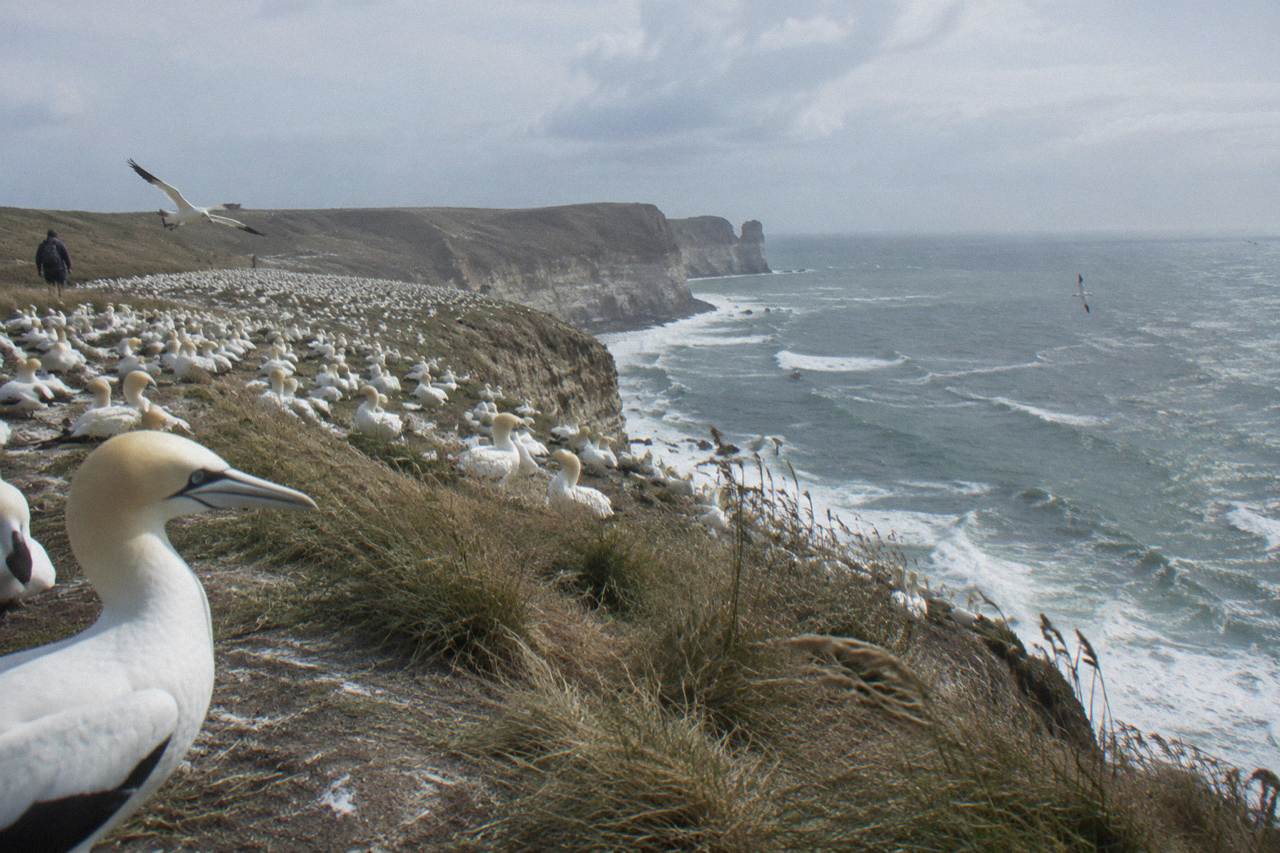
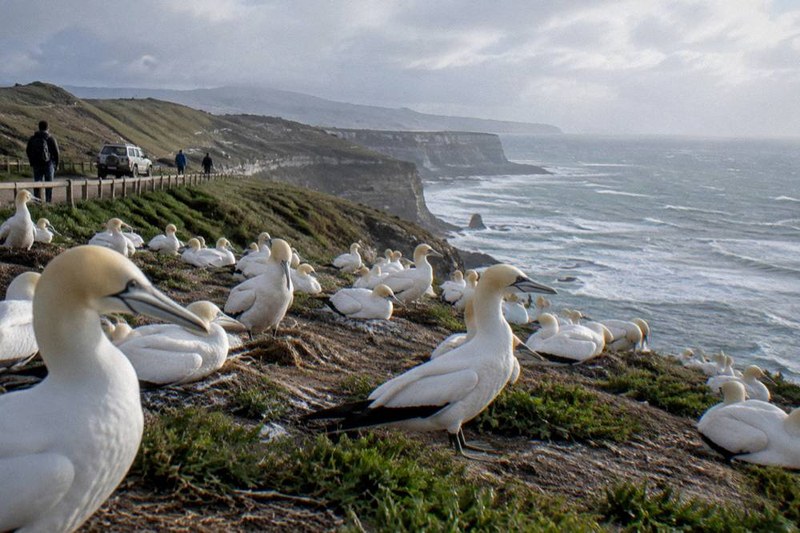
A group of gannets nesting together is called a colony, and the word for a gannet colony specifically is a gannetry. Both words describe the same thing: a place where pairs of gannets gather each breeding season to court, build nests, lay a single egg and raise a chick, packed shoulder to shoulder on cliffs and plateaus rather than spread across open water. At Cape Kidnappers, the headland south of Napier in Hawke's Bay, that gannetry is enormous. The Department of Conservation puts it at 6,500 pairs and calls it the largest and most accessible mainland gannet colony in the world.
The word matters more than it first appears. Knowing what a gannetry is tells you what you are walking or driving toward: not a loose scattering of seabirds but a dense, noisy, tightly organised breeding settlement, one that gannets return to year after year. This page explains the term, the behaviour behind it, and the practical side of seeing the Cape Kidnappers gannetry for yourself.
A group of gannets nesting together is called a colony, and a colony of gannets is also called a gannetry. The two words mean the same thing in everyday use, though gannetry is the more precise term, reserved for gannets alone, the way a rookery belongs to rooks and penguins. A gannetry is a breeding settlement, not a casual flock.
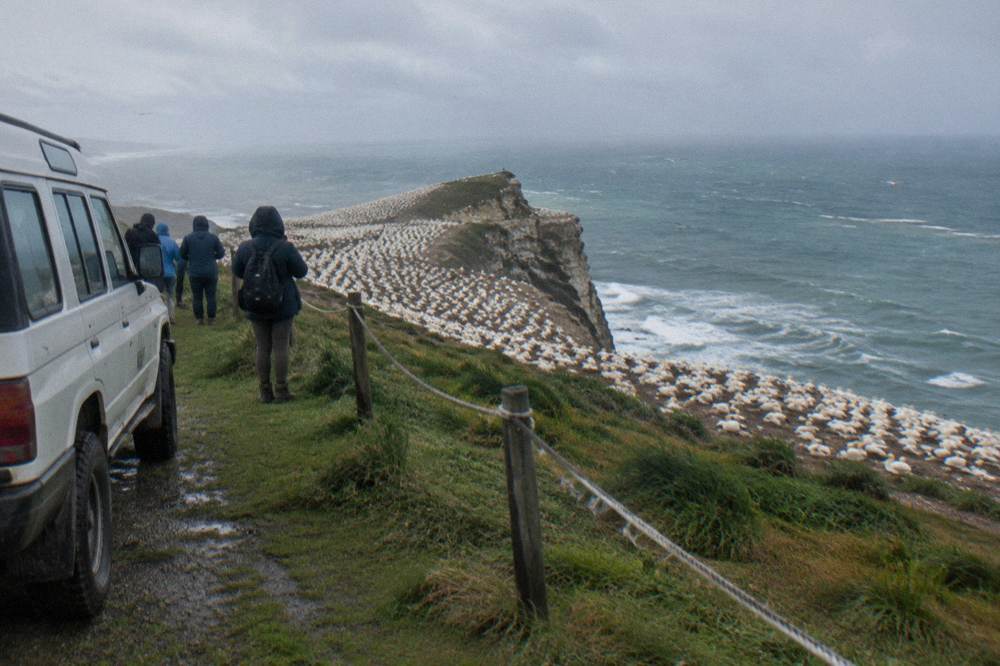
A flock of gannets feeding at sea, circling and diving over a school of fish, is not a gannetry. Birders call that a feeding aggregation, and it dissolves when the fish move on. A gannetry is defined by nesting. Pairs stake out small territories, sometimes little more than a wingspan wide, and defend them against neighbours with threat displays and the occasional jab of the bill. The result is the dense white carpet you see in photographs of Cape Kidnappers: thousands of birds spaced with surprising regularity, each pair at the centre of its own small circle of ground.
The word gannetry follows an old English pattern. New Zealanders sometimes use the Maori name for the Australasian gannet, takapu, and for the bird the name sits comfortably beside the English ones. The colony at Cape Kidnappers is part of the Te Kauwae-a-Maui Gannet Reserve, a name that ties the headland to Maori tradition as well as to the birds themselves.
So when a tour description says it visits "the gannet colony" or "the gannetry at Cape Kidnappers", it means the same breeding settlement on and above the cliffs at the end of the cape. The Department of Conservation recognises nesting sites there at Black Reef and at the Plateau, and it describes the Plateau colony, on private land reached across a working farm, as the best place to view nesting gannets. That Plateau is what the overland tours from Napier and Te Awanga are built around.
Where Is The Largest Gannetry You Can Visit?
The largest and most accessible mainland gannet colony in the world, in the Department of Conservation's words, is at Cape Kidnappers, about 25 minutes' drive from Napier in Hawke's Bay. DOC puts it at 6,500 pairs. Visitors reach the Cape Kidnappers gannet colony by 4WD tour, or on foot around low tide.
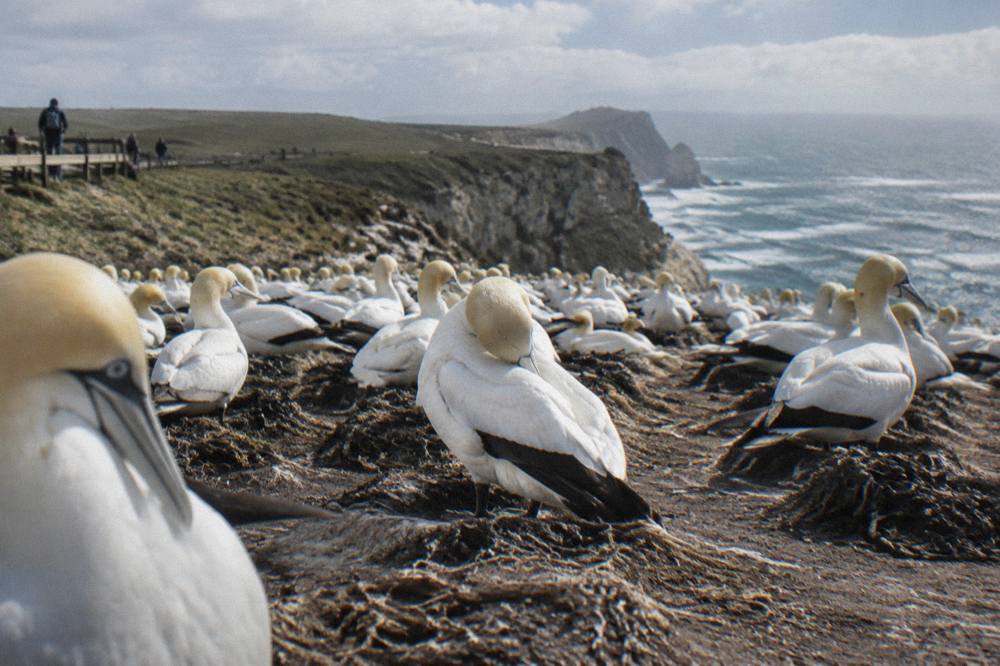
Mainland colonies are few, and mainland colonies you can actually stand beside, with a road or a walking track within reach, are fewer still. Cape Kidnappers is the standout. DOC records that gannets have nested there since the 1870s and that numbers have grown steadily to today's 6,500 pairs.
The colony is split across nesting sites. Black Reef is the first, sitting above the beach about 7.5 km from Clifton at the start of the walking route. Close-up views of nesting birds are possible at both. What makes the Plateau special is the access: it sits on privately owned land inside Cape Kidnappers Station, a working farm of roughly 2,500 hectares with a predator-proof fenced conservation area, and the overland tours cross that farmland by 4WD vehicle to reach seats a few metres from the birds.
- Standard Overland Gannet Tours$55
- Cruise Shore Excursions$93
- Private And Sunrise Tours$604 per group
That is the practical meaning of "most accessible". The DOC track from the beach to the plateau colony is closed each year from July to the week before Labour Weekend to limit disturbance to returning birds, and about 7 km of the beach walk runs beneath cliffs subject to significant landslide hazard. The overland route, by contrast, travels above the cliff tops across private farmland, which is why DOC describes it as the lower-risk option for reaching the colony. For a reader planning a Napier trip, the gannetry is the single biggest wildlife draw in the region, and it is reachable in a half-day.
Several tour options exist, and the choice comes down to start point, price and group style.
The 3-hour tour that meets at the operator's base at 396 Clifton Road, Te Awanga, is the most reviewed of the options, rated 4.9 across 1,052 reviews, from $56.23 per person. Hotel pickup can be added as an optional extra at booking, otherwise you drive yourself to the base, about 25 minutes from Napier. The same operator also runs the 3-Hour Tour, Lowest Price, from $55.00 per person, rated 4.8 across 378 reviews; it meets at 396 Clifton Road, Te Awanga, with light refreshments included. Private 4-hour tours are priced per group for up to four travellers. Whichever version you choose, the destination is the same: the bench seats on the flat plateau ground beside the gannetry.
How Do Gannets Behave Inside A Gannetry?
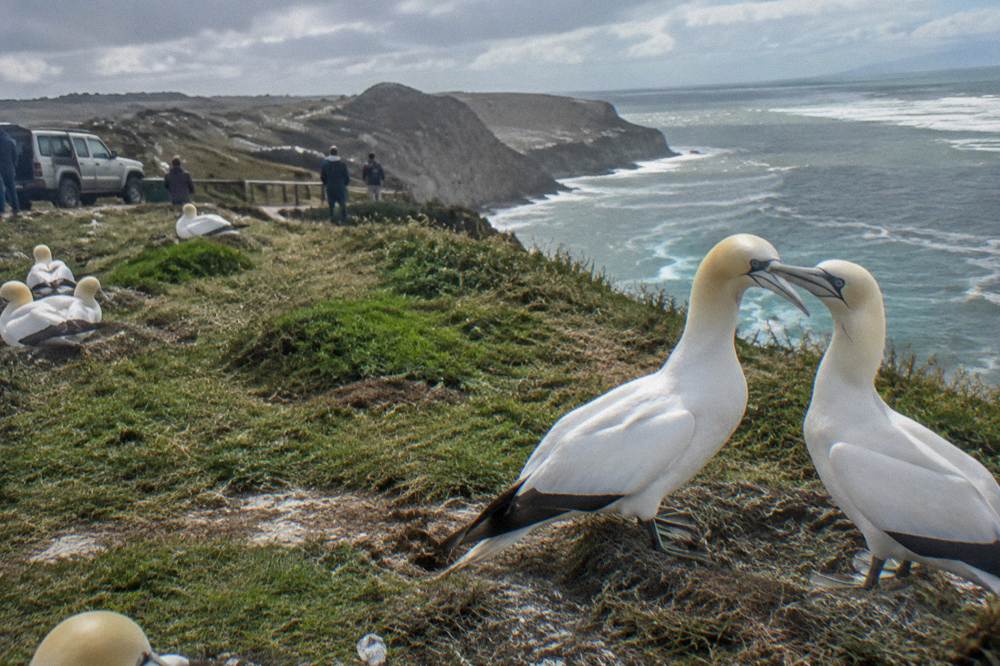
Inside a gannetry, paired gannets greet each other with elaborate displays, defend narrow nesting territories, and share every duty: a single egg is incubated by both parents on their webbed feet, and both feed the chick. Pairs stay together over many seasons, returning to the same spot. The noise, the bowing and the fencing bills are courtship and bonding, not fighting.
Stand at the edge of the Cape Kidnappers Plateau and the first thing that hits you is the sound. Thousands of gannets calling at once produce a continuous rattling roar, and the colony smells strongly of fish. Up close, the behaviour is what makes the visit memorable. A returning partner is met with a fencing display, two birds crossing and clattering their bills, followed by bowing, in which each bird lowers its head toward the nest. Sky-pointing, in which a gannet points its bill straight up, is a display seen at gannet colonies.
Pairs stay together over many seasons, and that long-term bond is the social glue of the gannetry. NZ Birds Online records that gannets lay a single egg and that both parents incubate it on their webbed feet rather than in a built nest of any complexity, the nest is really just an accumulated mound of seaweed, soil and grass. Adults have a wingspan of about 1.8 m, so a colony at full occupancy is a wall of white, black-tipped wings. DOC puts the Cape Kidnappers colony at 6,500 pairs.
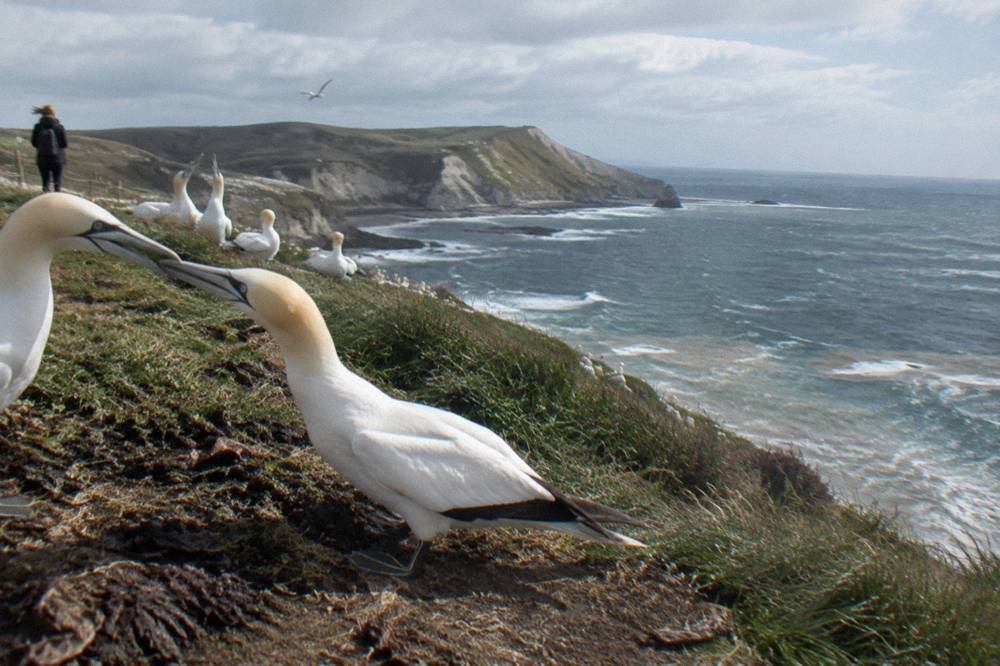
The colony runs on a seasonal clock. Adults return to the cape from around July for courtship and nest building, and the single egg follows later in the season. DOC names early November to late February as the best viewing window, when chicks and adults are both on the ground in numbers. DOC puts the Cape Kidnappers colony at 6,500 breeding pairs, with the best viewing from early November to late February. Gannets are not the only birds on the cape: white-fronted terns, variable oystercatchers, reef herons and Caspian terns work the shoreline, and little blue penguins nest around the headland.
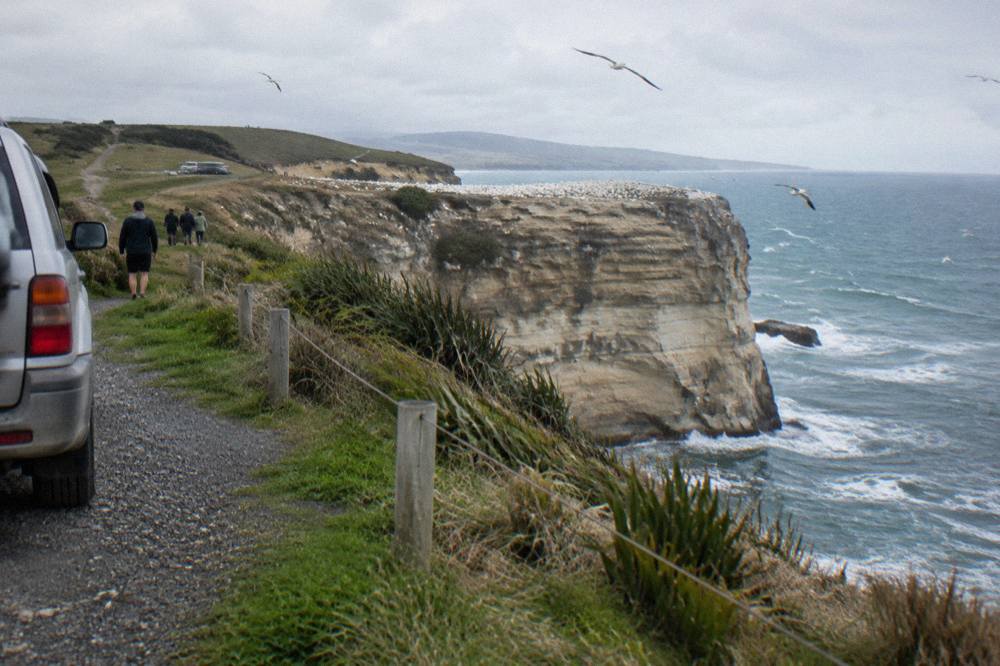
Cape Kidnappers is a gannet protection reserve. Visitors keep behind barriers or at least five metres from nesting birds, nesting birds dislike loud noises and fast movement, and dogs are not allowed anywhere in the reserve. The gannetry is both a wildlife sanctuary and a DOC reserve, and the overland tours, which include tea and coffee, are built around watching from the flat ground rather than walking among the nests.
What Time Of Year Should You See The Gannetry?
Tours to the Cape Kidnappers gannetry run from 1 August to 30 April each year, including Christmas Day. DOC names early November to late February as the best viewing window. The plateau track from the beach is closed from July to the week before Labour Weekend.
August and September are the courtship months. Adults return from around July, re-pair through bill fencing and bowing, and rebuild their nest mounds, so an early-season visit shows the displays at their most intense but the colony below full occupancy. DOC puts the best viewing window for the Cape Kidnappers colony between early November and late February. Weather can always affect a coastal trip: sea breezes, sun and sudden showers share the same day in Hawke's Bay, and the operator advises a jacket.
Late summer and autumn taper off as fledglings leave for the Tasman crossing, but the colony stays active until the season closes at the end of April. Tours pause through May, June and July, and the season runs 1 August to 30 April. The DOC track from the beach to the plateau colony stays closed from July to the week before Labour Weekend. Gannet Safaris Overland runs its tours from 1 August to 30 April, so there is nothing to book from May through July.
Cruise passengers get their own window. Napier's cruise ships call from October to April, which sits neatly inside the tour season and overlaps the best viewing period. The shore excursion options meet at 100 Marine Parade, opposite the Napier Museum and close to where the port shuttle drops at the Napier i-SITE, and departure times are set to match each ship. Passengers cannot walk out of the port itself; a shuttle runs from the wharf to the i-SITE and the National Aquarium.
Which Tour Best Suits A First Visit To The Colony?
For a first visit to the Cape Kidnappers gannetry, the 3-hour overland tour from the base at Te Awanga is the standard choice, from $56.23 per person and rated 4.9 across 1,052 reviews. The 3-Hour Tour, Lowest Price starts from $55.00 per person, rated 4.8 across 378 reviews, and meets at 396 Clifton Road, Te Awanga, with light refreshments included and no walking required.
The two shared 3-hour tours reach the same plateau by the same route, an air-conditioned 4WD ride across a working farm and native bush to the privately owned nature reserve above the cliffs. The differences are at the edges. The tour that meets at 396 Clifton Road asks you to drive about 25 minutes from Napier, or from Hastings and Havelock North, and offers hotel pickup as an optional add-on chosen at booking. Tea, coffee or other beverages are included on both.
The 3-hour tours are not for cruise passengers; the shore excursions, which run about 4 hours from Marine Parade, are the cruise options. For travellers who want the colony to themselves, the private options change the shape of the day. The 3-hour sunrise tour at $636.15 per group for up to four includes a gourmet breakfast with plunger coffee and juice, and runs about 45 minutes at the colony per its itinerary, with a per-group price rather than a per-person fare. There is also a private sunrise tour from $604.00 per group, and the $636.15 sunrise tour for up to four includes a gourmet breakfast with plunger coffee and juice.
Travellers with a full day and wider tastes can combine the gannetry with Hawke's Bay wine country on a private 7.5-hour winery combo, from $1,214.00 per group for up to two, travelling in a luxury Range Rover with pickup from your accommodation at about 8:30 am and returning by 4:00 pm. All of these are run by the one operator, and every one of them carries free cancellation up to 24 hours before the start. More on the practical planning side, including what to wear on the clifftop and how the seasons compare, sits in the Cape Kidnappers gannet season guide and the what to wear guide for a gannet tour.
For a deeper comparison of the three tours, this table lines up the facts that matter at booking time.
| 3-Hour Tour, Meet at Base | 3-Hour Tour, Lowest Price | Private 4-Hour Tour | |
|---|---|---|---|
| Price (USD, from) | $56.23 per person | $55.00 per person | $704.30 per group, up to 4 |
| Rating | 4.9 across 1,052 reviews | 4.8 across 378 reviews | 5.0 across 11 reviews |
| Duration | 3 hours approx. | 3 hours | 4 hours |
| Start point | 396 Clifton Road, Te Awanga | 396 Clifton Road, Te Awanga | Check at booking |
| Time at the colony | Check at booking | Check at booking | 45 minutes per itinerary |
| Refreshments | coffee and/or tea, beverages | light refreshments | coffee and tea |
| Group size | Check at booking | Check at booking | private to your group |
| Cancellation | free up to 24 hours before | free up to 24 hours before | free up to 24 hours before |
Can You See The Gannetry Without A Tour?
You can reach the Cape Kidnappers gannetry without a tour, but only on foot along the beach, and the walk is serious: 19 km return, graded Expert, possible only around low tide, with DOC advising at least 5 hours. A self-guided fat-bike ride of 3.5 to 4 hours also exists. The overland tours remain the only vehicle route to the Plateau.
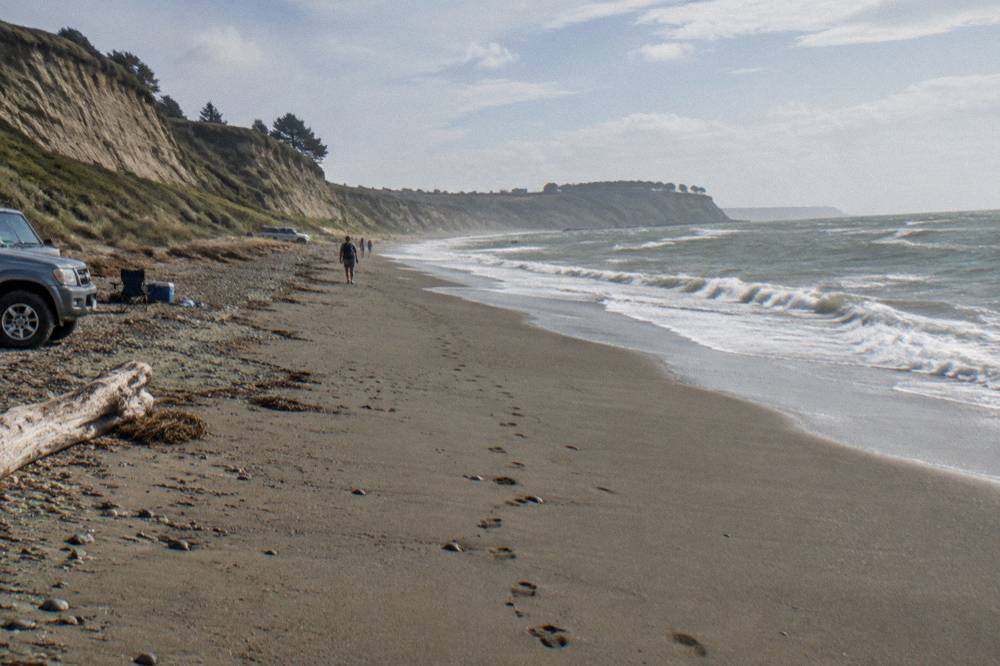
The beach walk starts at Clifton, Scotmans Point, 21 km south of Napier and 18 km east of Hastings. Black Reef, the first nesting site, sits 7.5 km along the beach, and a steep, rough, muddy climb of about 1 km leads on to the second colony. The tide governs everything: the walk is possible only around low tide, high tides and big seas block the beach, you must leave the Cape no later than 1.5 hours after low tide, and you should check the tide table before going. About 7 km of the route runs beneath cliffs subject to significant landslide hazard; a landslide seriously injured two tourists in January 2019, and another large landslide in February 2020 closed the beach before the track reopened. DOC says the status of the track can change at any time and to check the safety alert on its page, and a head torch, jacket, food, water and a communication device all belong in the pack. The full planning detail sits in the Cape Kidnappers walk guide.
Two other self-guided options exist beside the walking track. Gannet Bikes runs a self-guided fat-bike ride from 475 Clifton Road, 3.5 to 4 hours in total, needing at least intermediate fitness, with bike, helmet, spare tube, pump and map supplied and a short walk to the plateau colony at the end; check its own site for current details. Gannet Beach Adventures has offered a tide-dependent tractor-trailer ride along the beach from Clifton, though its running status should be checked on its own site before you plan around it. Neither carries a price here, and neither is the same product as the overland tours. Walkers and bike riders should also note that Clifton Motor Camp closed permanently in July 2026 after a geotechnical assessment found unstable land above it, and Hastings District Council voted to close a section of Clifton Road at the former campground to vehicles, though pedestrian access to the beach and the walking route stays open.
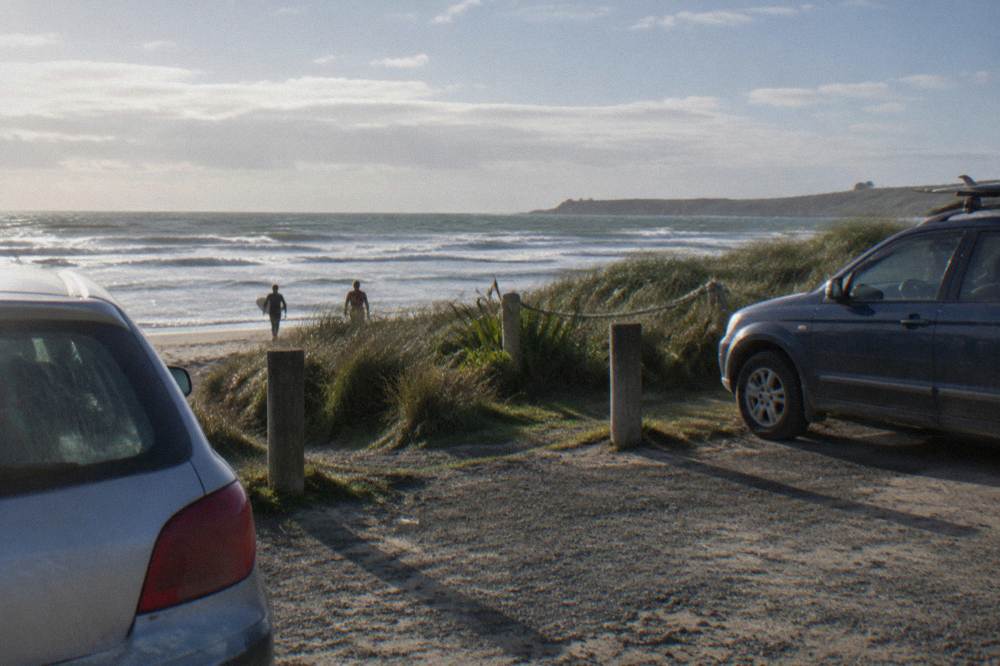
Against that backdrop, the overland tour earns its keep. The operator's tours are not governed by the tides because they travel above the cliff tops, the plateau itself is flat ground with bench seats where walking is safe and easy, and the operator says everything can be seen from the vehicle without getting out, a guest only needs to manage getting on and off unaided. For visitors with limited mobility, tight cruise schedules, or simply no wish to walk 19 km under landslide-prone cliffs, the 4WD route is the realistic way to stand beside a gannetry. The practical trade-offs between the two approaches are laid out in the walk versus overland tour comparison.
The 3-hour tour that meets at the base suits independent travellers with a car, while families and photographers wanting the plateau at their own pace can book the private 4-hour format.
Cruise passengers, again, should look to the dedicated shore excursions rather than the standard 3-hour tours, since those are not built for ship schedules. Cruise passengers can take the 4-hour shore excursion, which starts on Marine Parade a 200 m walk from the free ship shuttle drop at the Napier i-SITE. It runs from $95.42 per person and, per the itinerary, allows 45 minutes with the gannets. Always check the ship's all-aboard time against the tour's 4-hour length before booking.
Why Does The Word Gannetry Matter For Your Visit?
Knowing the word gannetry reframes the visit: you are not dropping in on scattered seabirds, you are entering a functioning breeding city that the birds rebuild every year. That explains the barriers, the five-metre rule, the seasonal closures and the quiet voice, every part of the visit is designed around protecting a settlement of 6,500 pairs.
It also explains the layout. A gannetry is dense by necessity: pairs need just enough ground for a nest and a landing space, so the colony spreads across every usable metre of plateau and reef. At Cape Kidnappers the best ground is the clifftop Plateau, which is why the birds concentrated there and why the tours are built to reach it. It explains the noise too, a colony this size is a continuous conversation of greeting calls, threat calls and contact calls, and it explains why the birds carry on regardless of visitors seated behind the barriers, the colony has its own business and the tour simply watches.
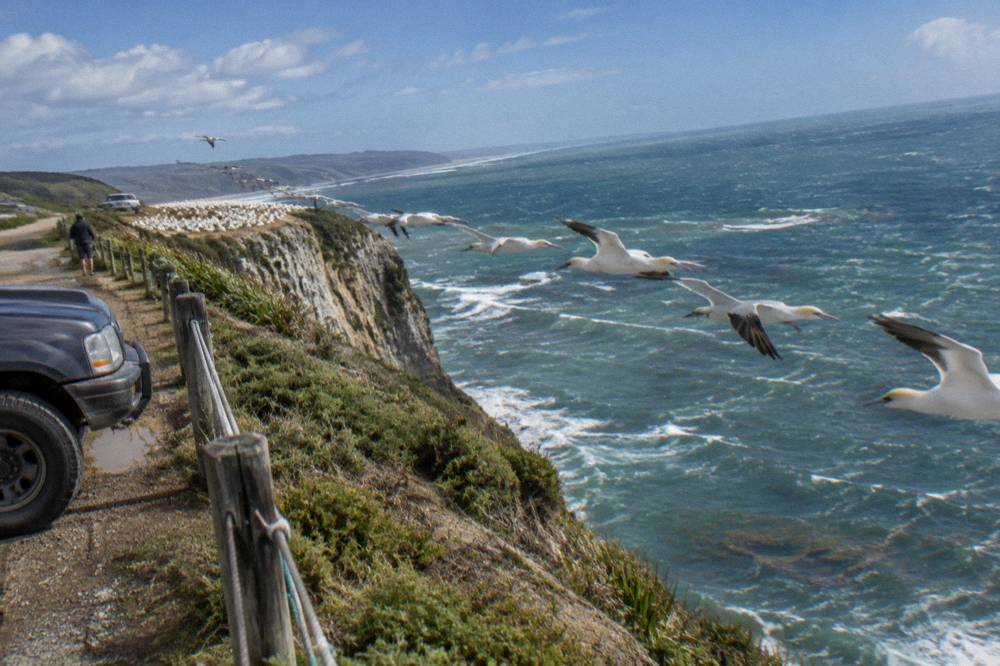
For photographers, the gannetry structure is a gift. A quick look at the Cape Kidnappers gannet photography guide covers the practical side, but the short version is that a dense colony at close range gives you behaviour shots, pairs fencing, bowing, incubating, and feeding, that no scattered flock can match. For families, the gannet tour with kids guide covers the pushchair-friendly reality of the overland route. However you arrive, the same word describes what you came for, and at Cape Kidnappers that word covers one of the great wildlife gatherings in the world. The full range of ways to reach it, from the shared 3-hour tours to the private sunrise format, is compared in the Cape Kidnappers gannet colony tours guide on this site, Napier Gannet Tour being the place to start.
Common Questions About Gannet Colonies
What Is A Group Of Gannets Called?
A group of gannets nesting together is called a colony, and a gannet colony is also known as a gannetry. The word describes a breeding settlement where pairs nest close together, not a casual flock of birds feeding at sea.
Where Is The Largest Mainland Gannetry In The World?
The Department of Conservation describes the Cape Kidnappers colony near Napier as the largest and most accessible mainland gannet colony in the world, putting it at 6,500 pairs. Gannets have nested there since the 1870s.
When Is The Best Time To See The Cape Kidnappers Gannetry?
Tours run from 1 August to 30 April. DOC names early November to late February as the best viewing window, when adults and chicks are both on the colony in numbers.
How Close Can You Get To The Gannets?
Keep behind barriers or at least five metres from nesting gannets. On the overland tours, bench seating on the flat plateau puts you within easy viewing distance without walking among the nests.
Can You See The Gannetry Without Taking A Tour?
Yes, on foot. The beach walk to the colony is 19 km return, graded Expert, possible only around low tide, with DOC advising at least 5 hours. A self-guided fat-bike ride of 3.5 to 4 hours also exists from Clifton.
Do Gannet Pairs Stay Together?
Yes. Pairs stay together over many seasons, greeting each other with bill-fencing and bowing displays, and both parents incubate the single egg on their webbed feet and share feeding of the chick.