Cape Kidnappers Vs Muriwai Gannet Colony: Which To Visit
Cape Kidnappers is the Hawke's Bay gannet colony, and Muriwai near Auckland is another colony people compare it with when time is short. Here is what is known about Cape Kidnappers, and how to think about the choice.
Short answer
Cape Kidnappers near Napier holds about 6,500 pairs of gannets, which DOC calls the largest and most accessible mainland colony in the world. Guided overland tours run from 1 August to 30 April, from $55.00 per person. Muriwai near Auckland is another gannet colony; check its own official page for its figures and access.
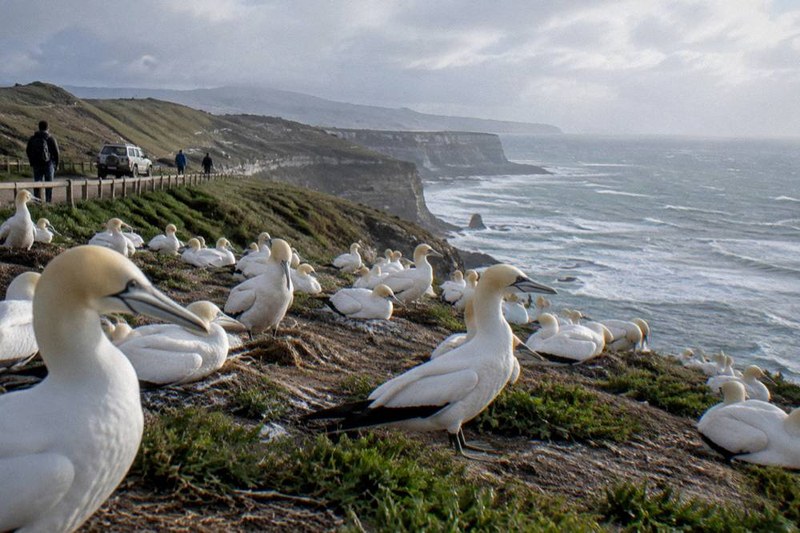
Two of New Zealand's few mainland gannet colonies: Cape Kidnappers on the Hawke's Bay coast south of Napier, and Muriwai on the west coast near Auckland. Both are mainland Australasian gannet colonies. At Muriwai the birds breed at Ōtakamiro Point, viewed from a platform and lookouts, and nest throughout summer. At Cape Kidnappers the colony sits on the plateau above the Pacific.
The comparison rests on the known facts about Cape Kidnappers. DOC puts the colony there at 6,500 pairs and calls it the largest and most accessible mainland gannet colony in the world. The colony sits on and above a working farm reached by guided overland tour, or by a long, tide-dependent beach walk. Muriwai is a different site with its own managers, its own access rules and its own viewing season, so check Muriwai's own official page for its side of the comparison. The Hawke's Bay option gets the full treatment here instead, from colony access to tour choices. Since the guided overland tour and the tide-dependent beach walk involve very different costs and commitments, the guide to Cape Kidnappers tour prices versus walking lays out exactly what each option demands.
If your trip already includes Napier or Hawke's Bay, the choice mostly makes itself: Cape Kidnappers is about a 25 minute drive from Napier, with several tour formats and price points. If you are based in Auckland, Muriwai is the nearer of the two. For everyone else, the deciding factors are usually colony size, ease of access and how much of a day you want to spend on it.
What Is The Difference Between Cape Kidnappers And Muriwai?
Both colonies host Australasian gannets, but they differ in scale, setting and how you reach them. Cape Kidnappers holds about 6,500 pairs across clifftop sites south of Napier and is reached by guided 4WD tour across a working farm or by a 19 km return beach walk. Muriwai is a west coast colony near Auckland with its own access arrangements; check its official page for current details. If Cape Kidnappers is the colony you want to see, the guide to the gannet colony near Napier explains how to get there from the city and which tour, walk or shore excursion suits your plans.
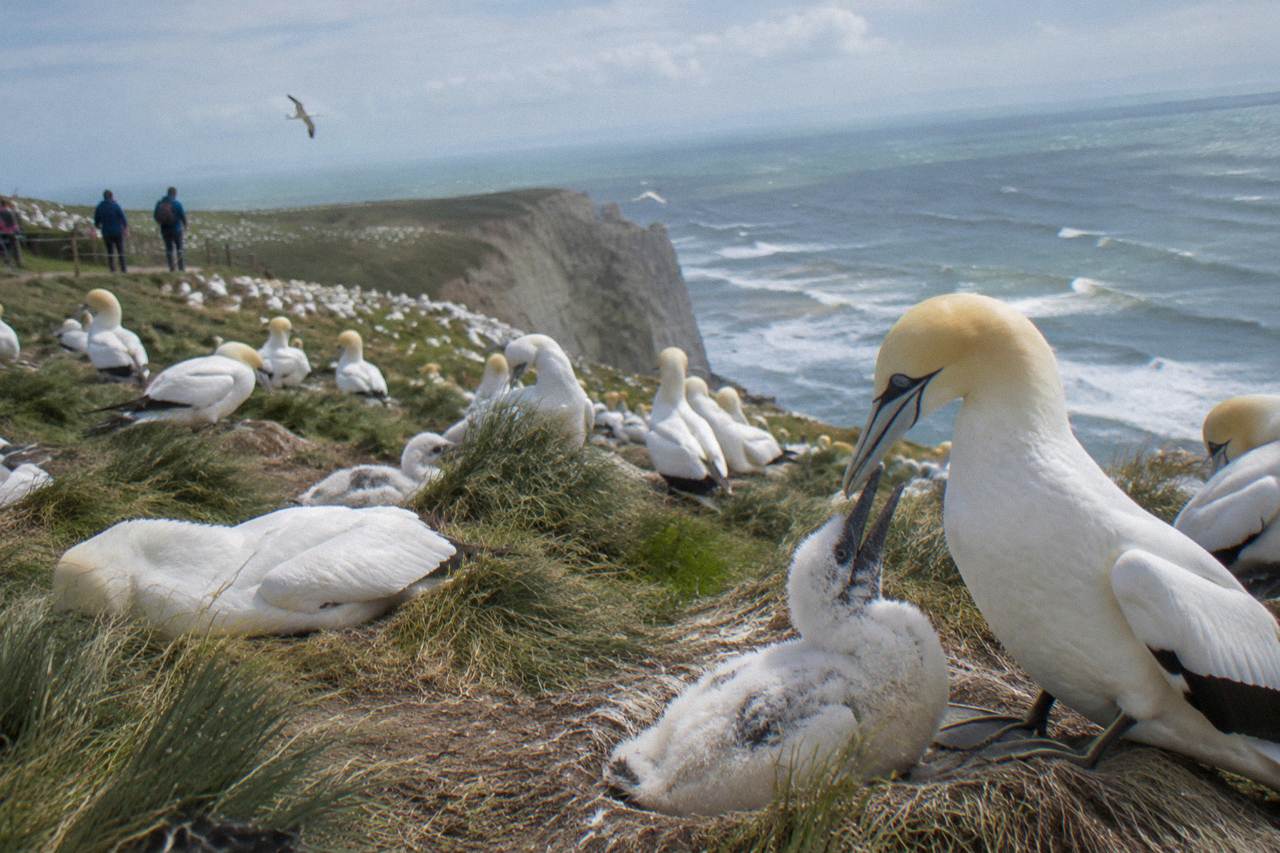
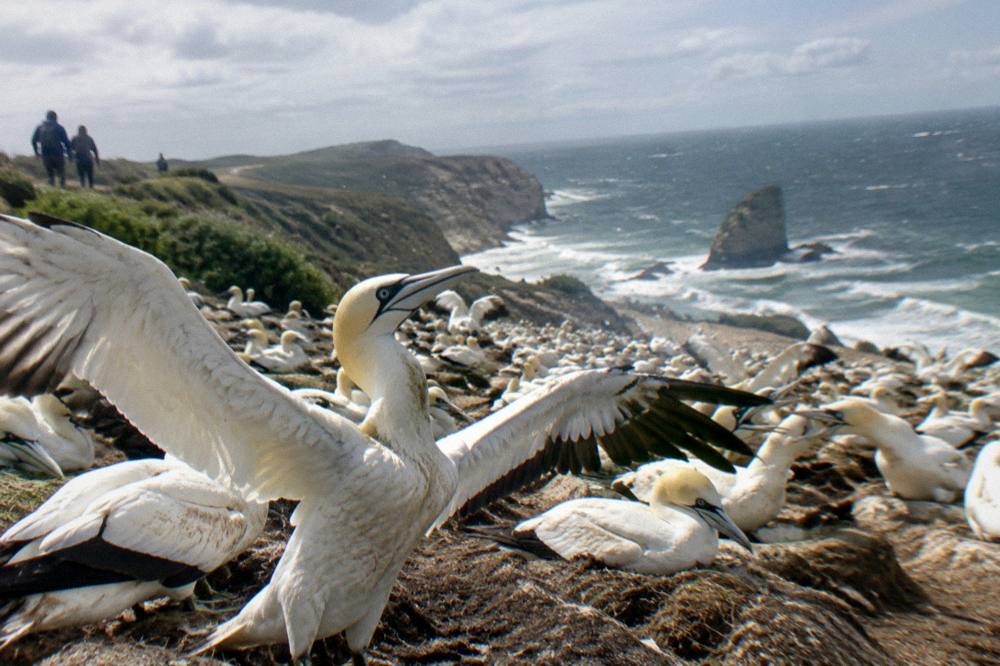
Start with what the birds have in common, because it explains why both places are popular. Australasian gannets, takapu, are large seabirds with a wingspan of about 1.8 m. They nest in dense colonies, sometimes called ganneries, on clifftops and headlands, laying a single egg that both parents incubate on their webbed feet. Pairs stay together over many seasons. Young birds fledge and typically return to the cape in their third year. DOC notes gannets have been nesting at Cape Kidnappers since the 1870s and can live 25 to 40 years.
- Standard Overland Gannet Tours$55
- Cruise Shore Excursions$93
- Private And Sunrise Tours$604 per group
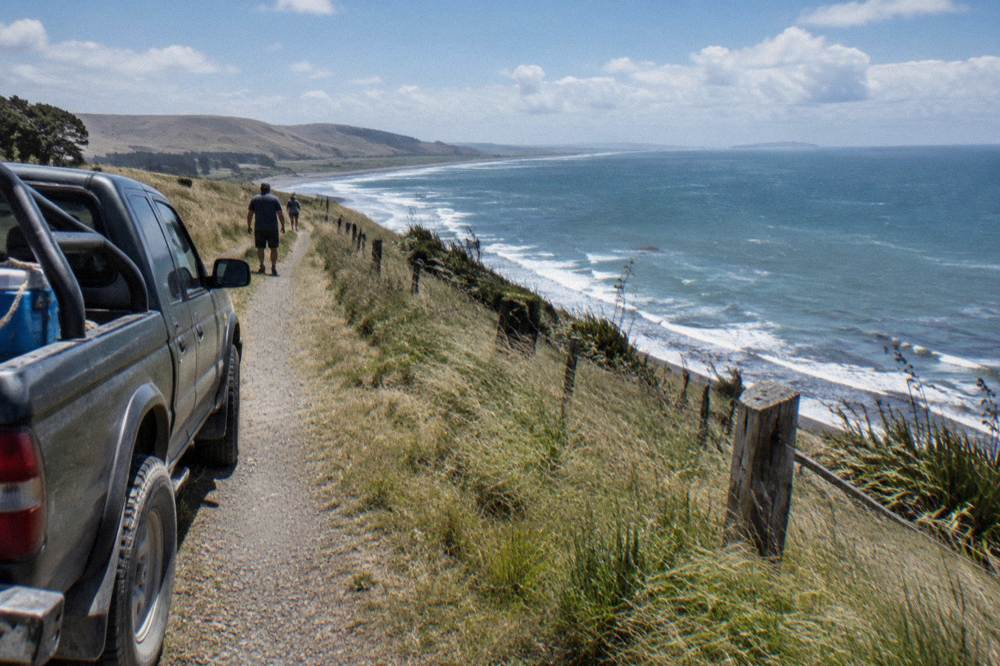
The differences are practical. Cape Kidnappers' main viewing area, the Plateau colony, sits on private land inside a roughly 2,500 hectare working farm, Cape Kidnappers Station, which includes a predator-proof fenced conservation area. You get there by vehicle, on a guided overland tour, or on foot along the beach. The colony's scale is its headline: 6,500 pairs, the figure DOC uses, described as the largest and most accessible mainland colony in the world.
Muriwai's colony sits at Otakamiro Point, at the southern end of Muriwai Regional Park west of Auckland, one of the few mainland gannet breeding sites. Visitors view it from a platform and lookouts, and the colony is seasonal, so check its official page for current details. If Muriwai is your realistic option, its own official park page is the right source for what is open, when the birds are there and what a visit involves.
There is also a positioning difference worth naming. Cape Kidnappers is a half-day outing from Napier with a tour industry built around it, from a $55.00 per person shared seat to private tours priced per group. Which suits you depends on whether you want a guided overland safari or a walk on the Maukatia Gannet Track.
How Big Is The Cape Kidnappers Gannet Colony Compared To Others?
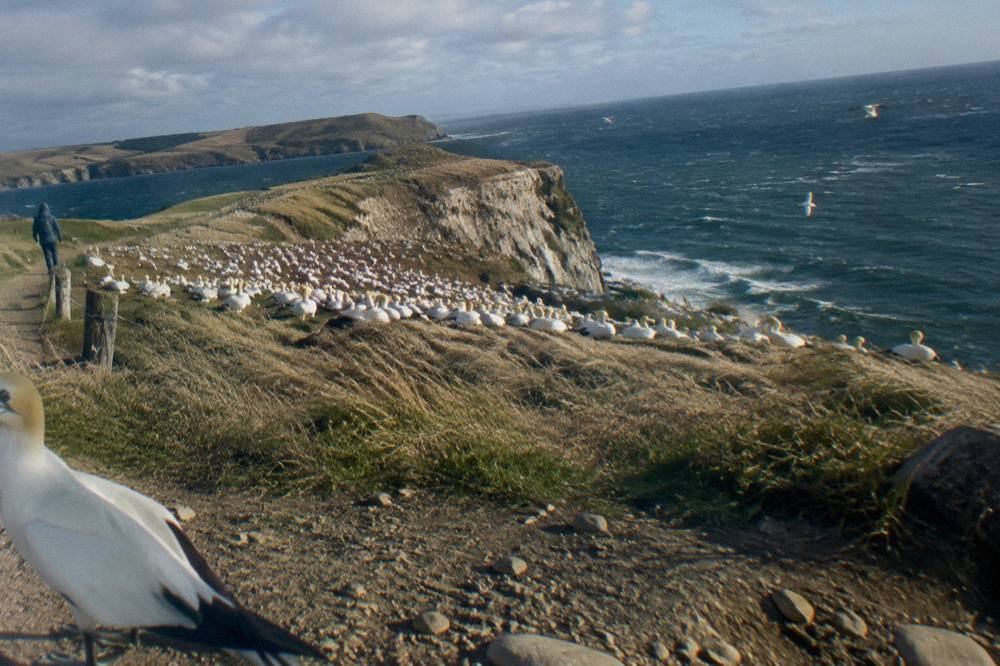
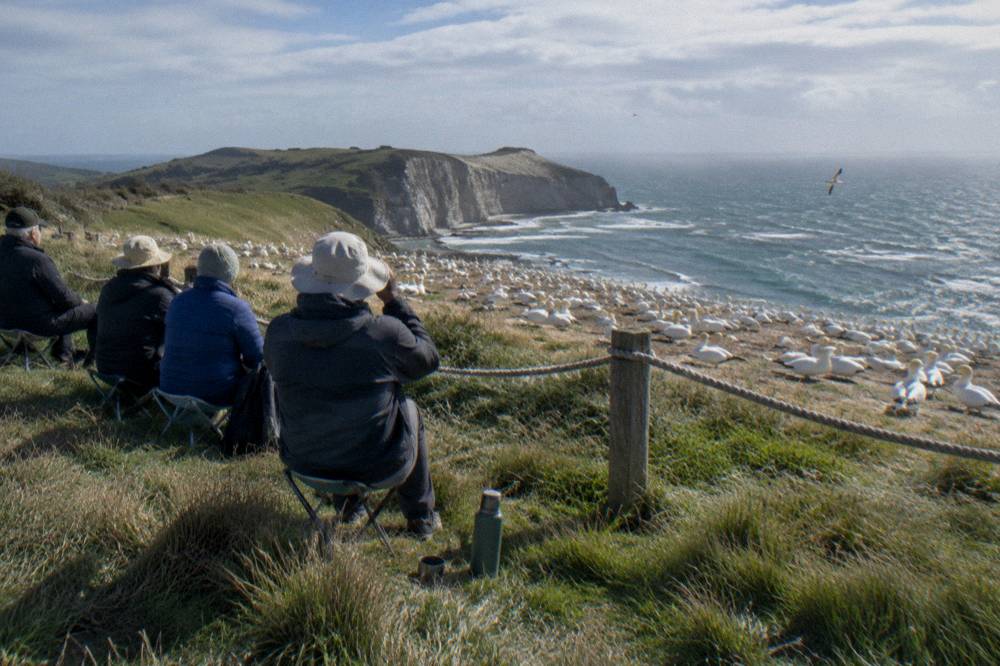
DOC puts Cape Kidnappers at 6,500 pairs of Australasian gannets and describes it as the largest and most accessible mainland colony in the world. The birds nest across several sites, with Black Reef the first nesting site on the beach approach and the Plateau colony, on private land, the best place to view nesting gannets.
The 6,500 pairs figure is DOC's, and it is the one to trust over the rounder, larger numbers that circulate in tourism copy. The colony is not one single spot: walking north from Clifton along the beach, Black Reef is the first nesting site, 7.5 km from the start, and a steep, rough, muddy climb of about 1 km leads on toward the second colony. DOC says the best place to view nesting gannets is the Plateau colony, which is on private land, and close-up views of nesting birds are possible at the Plateau and Black Reef colonies.
The overland tours deliver you to the Plateau without any of that effort. The operator describes the plateau as flat ground with bench seats, where walking is safe and easy, and where everything can also be seen from the vehicle without getting out. Little or no walking is required; a guest needs to be able to get on and off the vehicle unaided. Tea, coffee and a biscuit are served at the colony.
Beyond the gannets, the cape hosts white-fronted terns, variable oystercatchers, reef herons, Caspian terns, and little blue penguins nesting around the coast. For a photographer weighing Cape Kidnappers against a colony closer to Auckland, the appeal here is density and setting: thousands of pairs on a clifftop above the Pacific, viewed either from a bench seat or across a beach approach, weather permitting.
If that density tips your decision toward Hawke's Bay, these are the three tour formats most visitors compare:
The first two are shared, per-person overland tours; the third is a private four hour option priced per group of up to four. The sections below break down what each one includes and what it costs.
What Are Your Options For Seeing The Cape Kidnappers Gannets?
Four main formats exist: a 3 hour shared tour from $56.23 per person meeting at the operator's base with hotel pickup as an optional add-on at booking, a 3 hour shared tour from $55.00 per person meeting at the same base with no hotel pickup, a 4 hour shore excursion from $95.42 per person for cruise passengers, and private tours from $604.00 to $704.30 per group of up to four. A free-for-walkers beach route also exists but is a serious undertaking.
Two shared three hour tours cover the same ground and differ mainly in how you start. The "3-Hour Tour, Meet at Base" option runs from $56.23 per person, is rated 4.9 across 1,052 reviews, and starts at 396 Clifton Road, Te Awanga, with hotel pickup available as an optional add-on chosen at booking. It runs in an air-conditioned minivan and includes coffee or tea. The "3-Hour Tour, Lowest Price" option runs from $55.00 per person and is rated 4.8 across 378 reviews. It meets at 396 Clifton Road, Te Awanga.
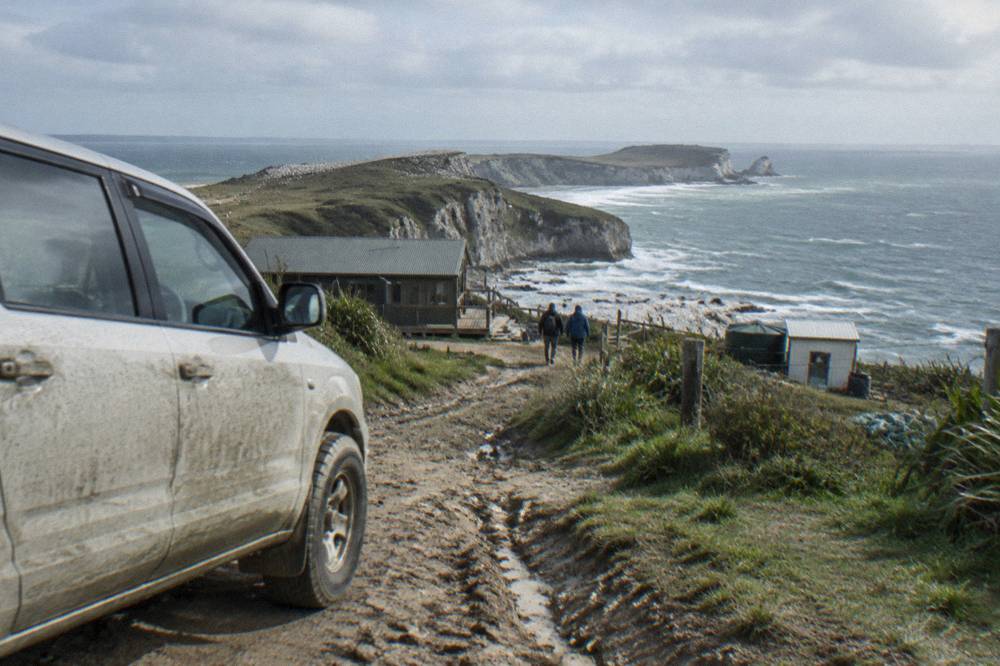
Private formats suit families and photographers who want the vehicle to themselves. The "Private 4-Hour Tour" runs from $704.30 per group of up to four, includes 45 minutes at the colony per its itinerary, and serves coffee or tea. A "Private 4-Hour, Pickup Included" version runs from $688.00 per group of up to four with hotel pickup and drop-off, and morning or afternoon tea and coffee. Because both are priced per group, not per person, they are not directly comparable with the shared per-person fares without saying so.
Cruise passengers have their own products. Only the shore excursions are built for cruise days: the "4-Hour Shore Excursion, 45-Minute Stop" from $95.42 per person, meeting at 100 Marine Parade opposite the Napier Museum, about 200 m from where the cruise shuttle drops, and a "4WD Safari Vehicle, 4 Hours" option from $93.00 per person, meeting at the pink flag area in front of the Sound Shell next to the i-SITE. The standard 3 hour tours are not for cruise passengers, so do not book one hoping to make it back to the ship.
| Tour | Price (from) | Basis | Duration | Reviews | Cruise passengers |
|---|---|---|---|---|---|
| 3-Hour Tour, Meet at Base | $56.23 | per person | 3 hours | 4.9 across 1,052 | No |
| 3-Hour Tour, Lowest Price | $55.00 | per person | 3 hours | 4.8 across 378 | No |
| 4-Hour Shore Excursion, 45-Minute Stop | $95.42 | per person | 4 hours | 4.9 across 10 reviews | Yes |
| 4WD Safari Vehicle, 4 Hours | $93.00 | per person | 4 hours | New listing | Yes |
| Private 4-Hour Tour | $704.30 | per group (up to 4) | 4 hours | 5.0 across 11 reviews | Check the booking page |
| Private 4-Hour, Pickup Included | $688.00 | per group (up to 4) | 4 hours | 5.0 across 4 reviews | Check the booking page |
| 3-Hour Sunrise Tour | $636.15 | per group (up to 4) | 3 hours | 3 reviews | Check the booking page |
| 3-Hour Sunrise, Pickup Included | $604.00 | per group (up to 4) | 3 hours | 5.0 across 3 reviews | Check the booking page |
The sunrise versions run three hours each in the early light; the one that meets at Clifton Road includes a gourmet breakfast with plunger coffee and juice. Every tour on this page carries free cancellation up to 24 hours before the start, which matters when you are planning around weather or a hire car itinerary.
Is The Cape Kidnappers Gannet Colony Easy To Reach From Napier?
Yes, the operator's base at 396 Clifton Road, Te Awanga is about a 25 minute drive from Napier, and the lowest-price shared tour meets you there rather than collecting you, so the drive out is yours to make. Cruise meeting points vary by tour: one meets at 100 Marine Parade, 200 m from the shuttle drop, the other at the pink flag by the Sound Shell.
The geography is simple. Cape Kidnappers sits at the southern end of Hawke's Bay, with the beach walk start at Clifton, 21 km south of Napier and 18 km east of Hastings. The operator's base is at 396 Clifton Road, Te Awanga, about 25 minutes from Napier, and the same from Hastings and Havelock North. The base has a large off-road car park with room for several motorhomes, and good bathroom facilities, worth knowing because there are no toilets on the tour itself; the last toilets are at the base.
The two shared three hour tours handle the drive differently. The meet-at-base version starts at Clifton Road, with hotel pickup as an optional add-on chosen when you book. Without a car, the easier call is 3-Hour Tour, Meet at Base, which offers hotel pickup as an optional add-on at booking, though the $55 tour simply meets you at the base at 396 Clifton Road, Te Awanga. A guide to getting to Cape Kidnappers covers the driving routes in more detail.
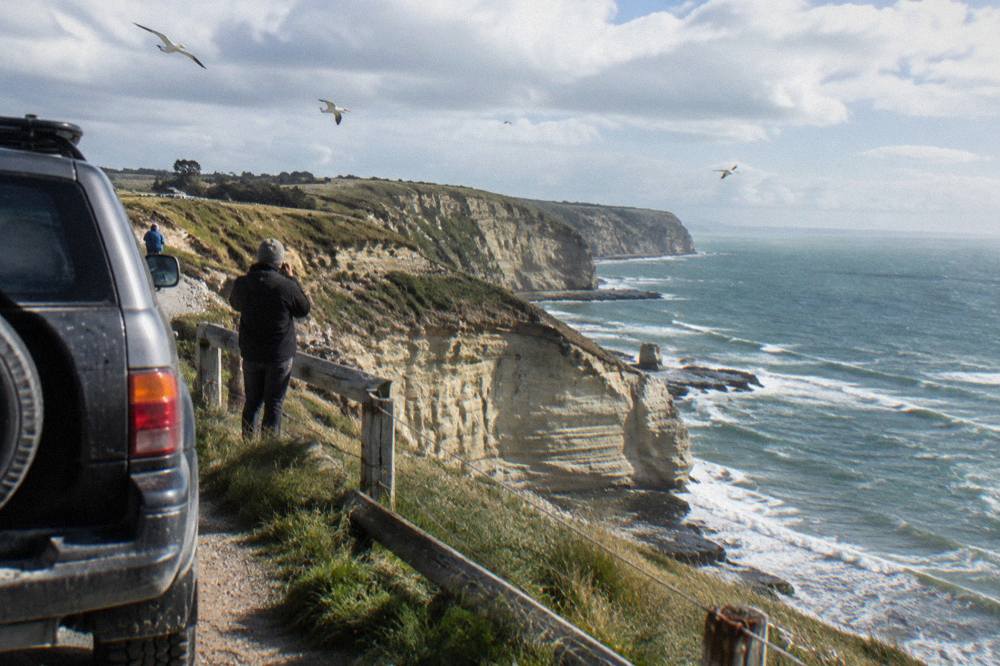
For cruise passengers the mechanics are tighter. Ships visit Napier from October to April. Passengers can walk down the gangway onto the wharf but cannot walk out of the port; a shuttle runs to two stops, the Napier i-SITE at 100 Marine Parade and the National Aquarium of New Zealand, and taxis cannot enter the port. The shore excursion meeting point is about 200 m from that shuttle drop, and on some ship days the operator collects directly from the port because of short port times, with departure time set per ship. Check your ship's all-aboard time against the tour's 4 hour length before booking. The Napier shore excursion guide works through this in full.
By comparison, reaching Muriwai is an Auckland-side question with Auckland-side answers, and you should check its official page rather than any second-hand figure.
When Is The Best Time Of Year To See Gannets At Cape Kidnappers?
Tours run from 1 August to 30 April, and DOC says the best viewing is early November to late February, when nesting and chick-rearing are in full swing. Adults return to the cape from around July for courtship and nest building, and the DOC track to the plateau closes from July to the week before Labour Weekend.
The season has a clear rhythm. Adults arrive from around July to reclaim nest sites, court and build. DOC's best-viewing window of early November to late February is when the colony is at its busiest and closest, with birds on eggs and then chicks at various stages, though no specific hatch week or month can be promised, and no visitor should expect a guaranteed chick stage on any given day. Weather permitting, the birds put on a constant show of arrivals, departures and fishing dives.
The tour season, 1 August to 30 April, runs slightly wider than the prime window, and tours run including Christmas Day. Adults return to the colony from around July; DOC names early November to late February as the best viewing window. This site's gannet season guide breaks the months down.
| Period | What to expect at Cape Kidnappers |
|---|---|
| July | Adults return from around July for courtship and nest building; DOC track to plateau closed |
| 1 August to 30 April | Tour season; overland tours run, including Christmas Day |
| Early November to late February | DOC's best viewing window; peak nesting activity |
| July to week before Labour Weekend | DOC track from beach to plateau colony closed to limit disturbance |
| October to April | Napier cruise ship season; shore excursions operate |
One wrinkle worth knowing: the DOC track from the beach up to the plateau colony closes from July to the week before Labour Weekend each year to limit disturbance to returning birds, while the overland tours keep crossing private farmland on their own route. If your travel dates sit in that winter shoulder, the tour is the reliable way in. What you see on the day depends on the birds and the weather; operators describe the experience, but no departure, sighting or chick stage is ever guaranteed.
Can You Walk To The Gannets At Cape Kidnappers Instead Of Taking A Tour?
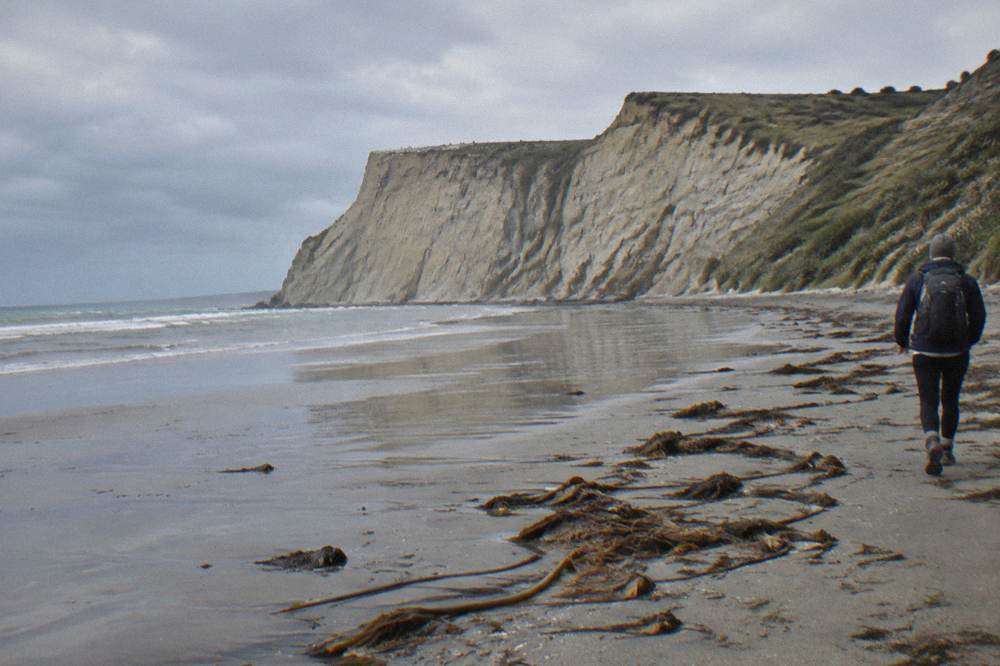
Yes, but it is a serious walk: 19 km return from Clifton along the beach, graded Expert, with DOC advising at least 5 hours for a comfortable return trip, and the route is possible only around low tide. High tides and big seas block the beach, and you must leave the Cape no later than 1.5 hours after low tide.
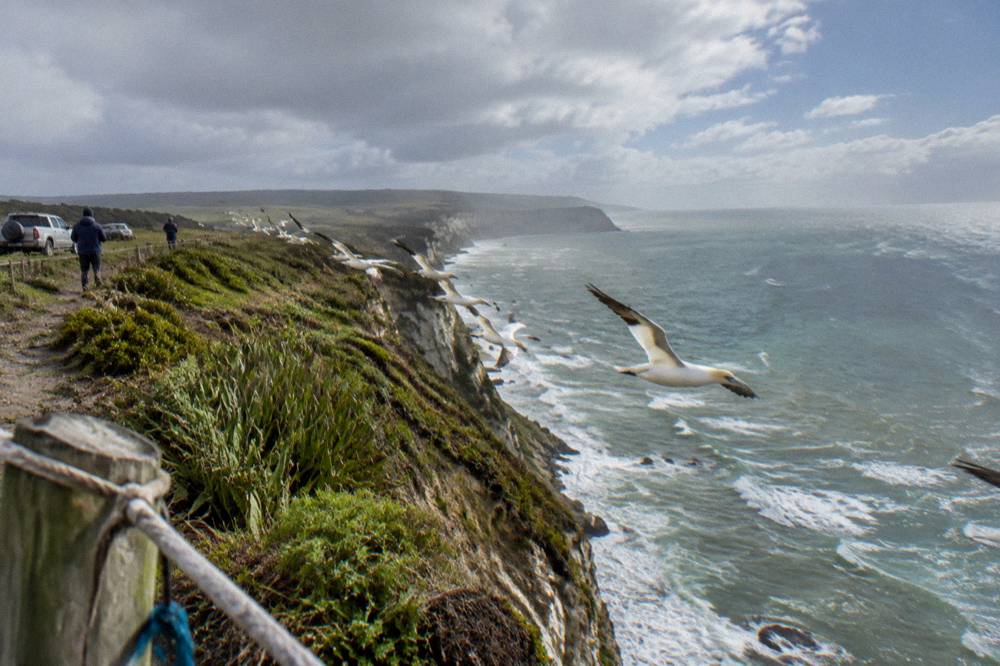
The walk is free in dollars and expensive in effort and risk. It starts at Clifton, Scotmans Point, and follows the shore north, with Black Reef's nesting site 7.5 km in. About 7 km of the beach lies beneath cliffs subject to significant landslide hazard: a landslide seriously injured two tourists in January 2019, another large landslide in February 2020 closed the beach for a time, and DOC reports large landslides every year. DOC says the track's status can change at any time, so check the safety alert on its page and the signage before setting out. A fuller treatment is in the Cape Kidnappers walk guide, and the tide times guide explains the planning.
DOC's own packing list signals the seriousness: sturdy footwear, food and water, sunscreen and hats, extra clothing for cool sea breezes, a water and windproof jacket, gloves, a head torch and a communication device. There is a DOC rest shelter with toilets a short way up the track from the beach end, but no drinking water. Dogs, horses, motorbikes, fires and camping are all prohibited, you must keep behind barriers or at least five metres from nesting gannets, and drones on conservation land need a DOC permit.
Two middle-ground options exist, run by other operators and described here factually only. Gannet Bikes offers a self-guided fat-bike ride from 475 Clifton Road, 3.5 to 4 hours in total, needing at least intermediate fitness, with bike, helmet, spare tube, pump and map supplied and a short walk to the plateau colony at the end. Gannet Beach Adventures runs a tide-dependent tractor-trailer ride along the beach from Clifton; check its own site for whether and when it operates. DOC treats beach transport as a high-risk operation and describes the overland route across private farmland as a lower-risk option. The walk versus overland tour comparison weighs the two directly, and a bike ride alternative guide covers the cycling option.
If walking or biking is your plan, one recent change matters: Clifton Motor Camp was closed in February 2026 after a geotechnical assessment found unstable land above it and permanently closed in July 2026, and in August 2026 the council voted to close a section of Clifton Road at the former campground to vehicles. Pedestrian access to Clifton Beach and the walking route stays open. This affects walkers and bike riders only; whether the operator base at 396 Clifton Road is affected is unconfirmed, so check when booking.
For the lowest per-person fare, this 3-hour tour meets at 396 Clifton Road, Te Awanga, with light refreshments:
From $55.00 per person with light refreshments included, it carries a 4.8 rating across 378 reviews and is the cheapest of the two tours with substantial review pools. It meets at 396 Clifton Road, Te Awanga, and you make your own way there. Walking is not required if you do not want to walk, though a jacket is advised.
Cape Kidnappers Or Muriwai: Which Should You Choose?
Choose Cape Kidnappers if you are in or near Hawke's Bay, want the largest mainland colony at 6,500 pairs, and like the idea of a guided 4WD ride across a working farm to a clifftop reserve. Choose Muriwai if Auckland is your base; the colony sits on Ōtakamiro Point at the southern end of Muriwai Regional Park.
Geography first. If your New Zealand trip runs through Auckland and nowhere near the east coast, adding Cape Kidnappers means a significant detour; Muriwai is the practical choice, and its own official page will tell you what is currently open and when the birds are present. If you are touring the North Island, or docking in Napier between October and April, Cape Kidnappers is right there, 25 minutes from the city with tours from $55.00 per person.
Then think about the kind of experience you want. Cape Kidnappers tours are structured: a vehicle, a driver-guide, farm commentary, bench seating at the plateau, tea or coffee, and a set three or four hour shape. That structure is exactly what many visitors want, and it is also what some would rather avoid. Muriwai's colony at Ōtakamiro Point is viewed from a platform and lookouts along the Maukatia Gannet Track, and gannets nest throughout summer.
| Factor | Cape Kidnappers | Muriwai |
|---|---|---|
| Species | Australasian gannet | Australasian gannet |
| Colony size | DOC puts it at 6,500 pairs, largest and most accessible mainland colony | Verify on its official page |
| Location | Hawke's Bay, about 25 minutes from Napier | West coast near Auckland |
| Access | Guided overland tour from $55.00 per person, or Expert-graded 19 km return beach walk | Verify on its official page |
| Tour season | 1 August to 30 April | Verify on its official page |
| Best viewing | Early November to late February (DOC) | Verify on its official page |
| Formats | Shared tours, cruise shore excursions, private and Private Sunrise tours | Verify on its official page |
If Cape Kidnappers wins out, the Napier and Hawke's Bay planning guide shows how to fill the rest of your visit around the gannet tour.
For photographers, the sunrise formats are the differentiator worth a close look. The "Private Sunrise" tours run three hours in early light for a group of up to four, from $604.00 with hotel pickup included on one version, or from $636.15 meeting at Clifton Road with a gourmet breakfast of pastries, fresh fruit and yoghurt, plunger coffee and juice on board. Both are priced per group, so a party of four splits that four ways if they choose to think about it that way.
Families and small groups who prefer their own vehicle at any hour should look at the private four hour formats:
The "Private 4-Hour Tour" runs from $704.30 per group of up to four, with 45 minutes at the colony per its itinerary and coffee or tea included, private to your group, with free cancellation up to 24 hours before the start. It suits a family, a photography group, or anyone who wants the bench seats and the driver-guide to themselves.
How Does The Cape Kidnappers Experience Fit Into A Hawke's Bay Day?
A Cape Kidnappers tour takes three to four hours plus travel, leaving most of a day for Napier's Art Deco quarter, wineries, or Te Mata Peak, and the cruise shore excursions are timed to fit a ship day. The standard tours are not for cruise passengers; only the shore excursion products are.
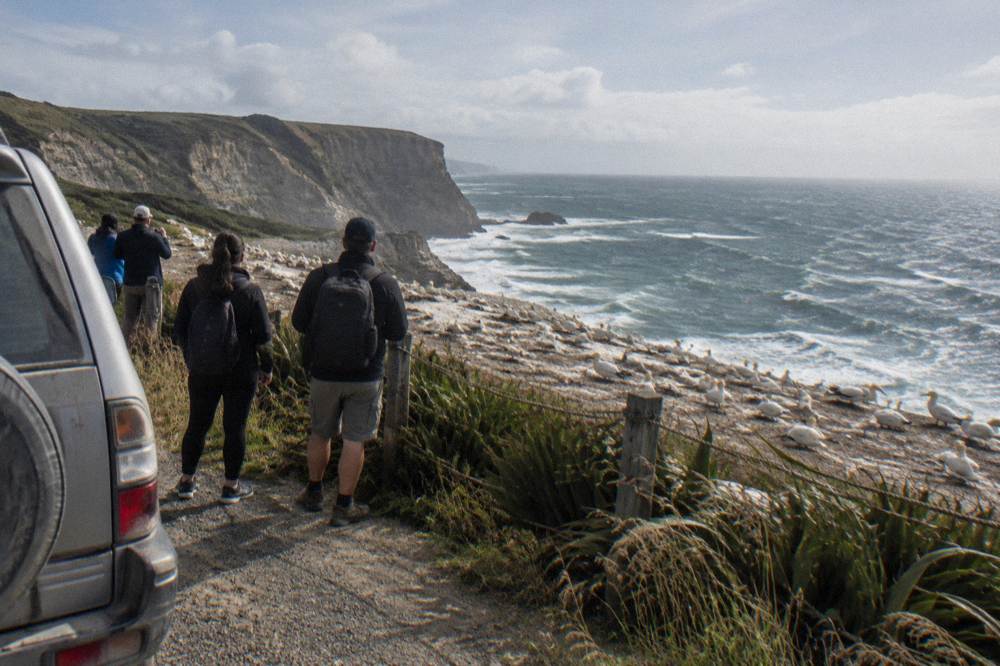
The three hour shared tours slot neatly into a morning or afternoon. With the base 25 minutes from Napier, a morning start leaves the afternoon free for the whole of Marine Parade, the Art Deco walk, or a cellar door run. The private winery combo that runs 7.5 hours, from $1,214.00 per group of up to two, with pickup from about 8:30 am and return by 4:00 pm in a luxury Range Rover, shows how some visitors fold the colony and the wine region into a single booked day.
Cruise passengers should be strict about the format. The two shore excursions, from $95.42 and $93.00 per person, run 4 hours from Napier and are designed around ship timings, with departure set per ship and, on some days, collection directly from the port. Check the all-aboard time before booking anything, and remember the standard 3 hour tours are not built for cruise days even though their timing might look like it fits. The shore excursion guide covers the meeting points and shuttle mechanics in detail, and Napier Gannet Tour exists to make exactly this kind of comparison quick.
For land-based visitors the advice is simpler: book the format that matches your transport. Have a car, or happy to drive 25 minutes? The meet-at-base tour from $56.23 per person is the most reviewed option at 4.9 across 1,052 reviews. No car, or prefer not to drive? The tour from $55.00 per person meets you at the Te Awanga base. Are you travelling as a family of four, or a photo group? The private formats run $604.00 to $704.30 per group for up to four, more than four seats on any shared tour, and the extra cost buys privacy plus a schedule of your choosing.
Whichever colony you choose, book with the weather in mind and keep the free cancellation window, up to 24 hours before the start on every tour here, as your margin. Conditions at a clifftop colony change fast, and operators can cancel or reschedule when they do.
Common Questions About Comparing Gannet Colonies
What Is The Difference Between Cape Kidnappers And Muriwai?
Both host Australasian gannets. Cape Kidnappers near Napier holds about 6,500 pairs, which DOC calls the largest and most accessible mainland colony in the world, and is reached by guided overland tour or a 19 km return beach walk. Muriwai near Auckland is a separate colony with its own access rules and season; check its own official page for current details.
Which Gannet Colony Is Bigger?
DOC puts Cape Kidnappers at 6,500 pairs and describes it as the largest and most accessible mainland colony in the world. Muriwai publishes its own figures on its official page, so check there before comparing the two colonies.
How Much Does A Cape Kidnappers Gannet Tour Cost?
Shared 3 hour tours run from $55.00 per person or from $56.23 per person, both meeting at 396 Clifton Road, Te Awanga; only the pricier tour offers optional pickup for a fee. Cruise shore excursions run from $93.00 and $95.42 per person, and private tours for a group of up to four run from $604.00 to $704.30 per group. All figures are "from" prices in USD.
Can Cruise Passengers Visit The Cape Kidnappers Gannet Colony?
Yes, via the two shore excursion tours, which run 4 hours from Napier and meet at 100 Marine Parade near the i-SITE, with departure time set per ship. The standard 3 hour tours are not for cruise passengers.
When Is The Best Time To See Gannets At Cape Kidnappers?
Tours run 1 August to 30 April, and DOC says the best viewing is early November to late February. Adults return from around July for courtship and nest building.
Is The Cape Kidnappers Gannet Tour Worth It Compared To Muriwai?
If you are in Hawke's Bay or docking in Napier, the colony's scale, the guided farm crossing and the range of tour formats make it an easy call, from $55.00 per person. If you are Auckland-based, verify Muriwai's access and season on its official page before deciding; the right answer depends on where your trip already takes you.