When Do Gannet Chicks Hatch At Cape Kidnappers
The answer about chick timing at Cape Kidnappers, what DOC says about the best viewing window, and how to choose the month and the tour around it.
Short answer
Hatch timing shifts slightly each season, so no exact week can be promised. What is settled: adults return from around July, tours run 1 August to 30 April, and DOC names early November to late February as the best viewing window. Chicks and juvenile stages fall inside that window, but no stage can be promised on any given day.
The question every planner asks about Cape Kidnappers is also the one with the messiest answer. Hatch timing at the colony varies between accounts, and a week or month given with false confidence can send a traveller a long way at the wrong time. What is well supported is the frame around it: when the adult gannets arrive, when the Department of Conservation says viewing is at its best, and when the overland tours actually run. This guide works inside that frame, page by page, month by month, and then matches the season to the tour options that get you to the colony without a 19 kilometre beach walk. For a straight answer on which months actually deliver chicks at the colony, the guide to gannet chick timing at Cape Kidnappers pairs the best-viewing window with the tour season so you can pick a booking month without falling for promised hatch dates.
When Is The Gannet Season At Cape Kidnappers?
The season has three anchor points worth memorising. Adults return to the cape from around July for courtship and nest building. The overland tours run from 1 August to 30 April, including Christmas Day. DOC names early November to late February as the best viewing window, when nesting activity and young birds are at their most visible.
Those three dates do different jobs. The July return sets the earliest possible interest: birds are back, pairs are reuniting, and nest building is under way, but the colony is quieter and the tour season has not yet opened. The 1 August start of the tour season is the practical gate for almost every visitor, because the overland route across the working farm is how the great majority of people reach the plateau. The November-to-February window is the headline: that is when DOC says viewing is best, and it is the period a reader hoping to see fluffy chicks and awkward juveniles should aim for.
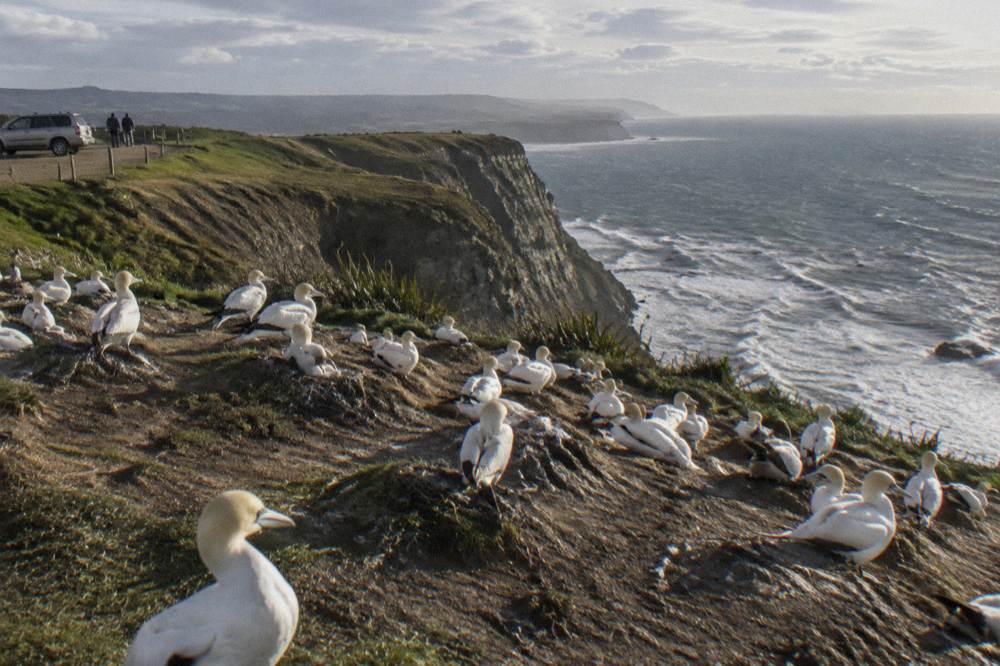
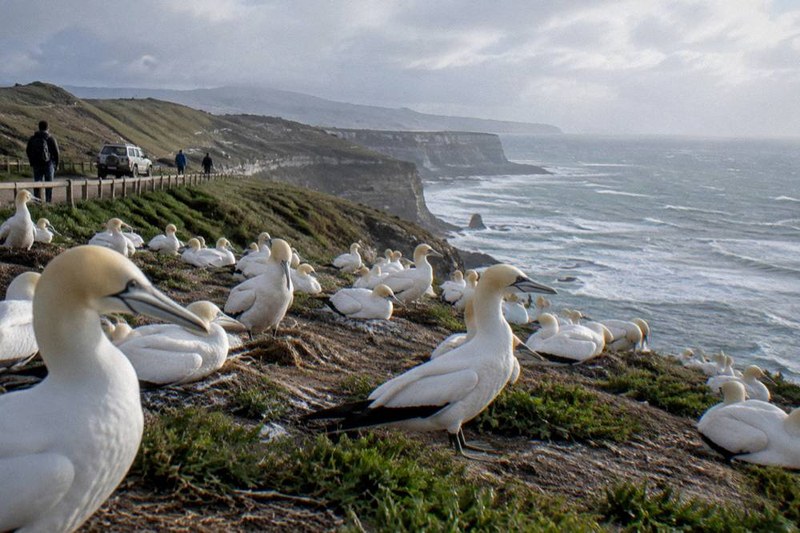
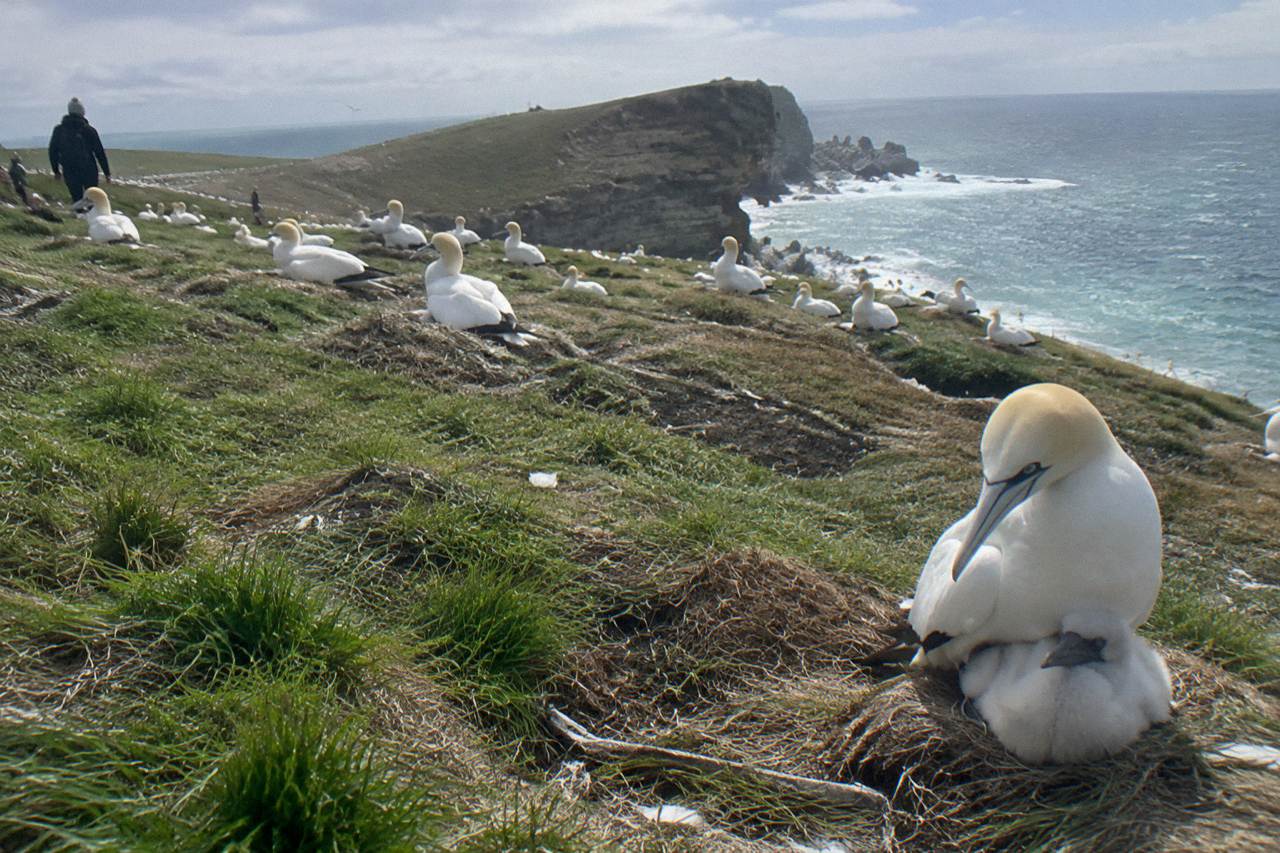
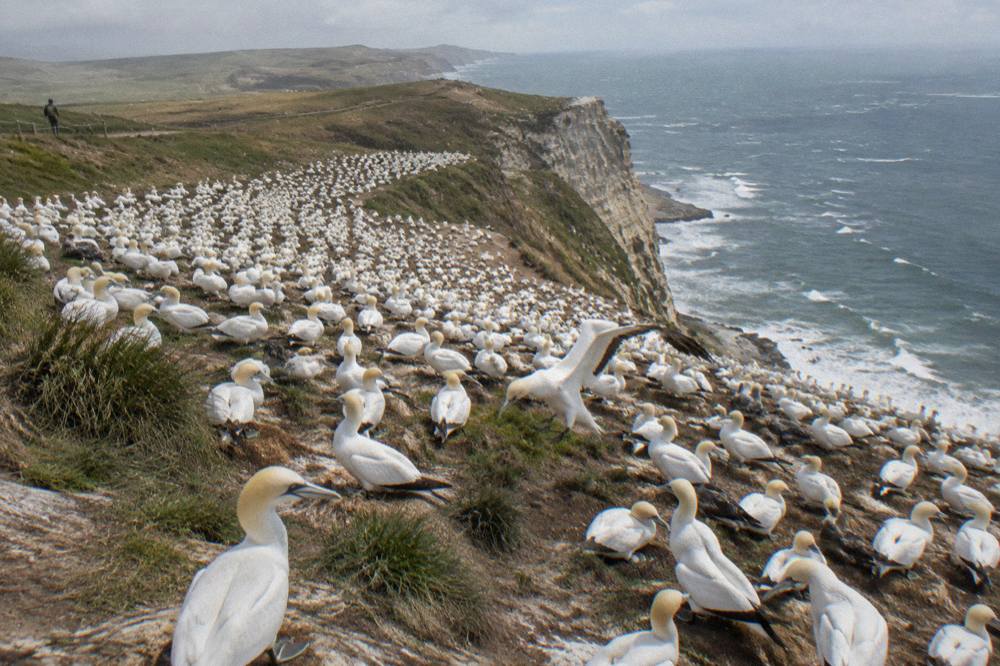
It helps to picture the colony as a rolling season rather than a single event. Gannets lay a single egg, and both parents incubate it on their webbed feet, a habit that makes nesting birds easy to read from the viewing area: a bird sitting low and motionless on its feet is very likely sitting on an egg. Because pairs nest at slightly different times across a colony DOC puts at 6,500 pairs, the plateau rarely shows one uniform stage. On a good summer day you can see courtship, eggs, downy chicks and gangly juveniles all within the same view.
| Period | What is happening at the colony | Practical note |
|---|---|---|
| From around July | Adults return, courtship and nest building | Tours have not yet started for the season |
| 1 August to late October | Tour season under way, nesting and laying under way | Quieter colony, fewer visitors, cooler weather |
| Early November to late February | DOC's best viewing window | Nesting, chicks and juveniles all likely visible |
| 1 March to 30 April | Juveniles and departing birds, season winding down | Later summer light, colony thinning out |
The table above is the shape of the year. No row promises a stage on a given day, because none can. Weather, the birds themselves and the stage spread across 6,500 pairs mean the only guarantee is that a summer visit shows you a lot of gannets doing a lot of different things.
For readers comparing colonies, the season logic at Cape Kidnappers also frames the Cape Kidnappers versus Muriwai comparison, where the size difference between the two sites is the main story.
Which Months Show Gannet Chicks At The Colony?
Early November to late February is the window DOC itself names for the best viewing, and that window is where chick stages fall. Within it, no week or month can be promised for hatching, because the colony's 6,500 pairs do not move in lockstep. Chick stages fall inside DOC's best viewing window, early November to late February, but no stage can be promised for any chosen week.
Hatch timing varies from season to season, and no week can be promised in advance; a colony this large also staggers its nesting. Some pairs are still renovating nests while neighbours are feeding half-grown chicks. The practical reading for a traveller is that November through February delivers a mix of stages, and that the later you go inside the window, the more large, independent juveniles you are likely to see relative to small downy chicks.
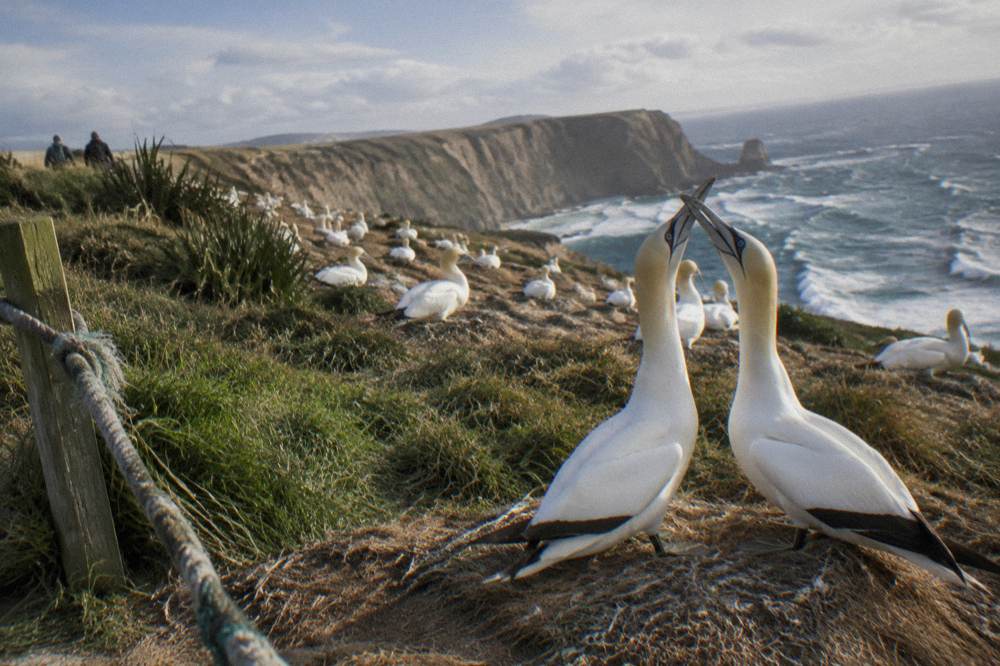
That mix is a feature, not a failure. A single visit inside the window can show the full arc: elaborate courtship displays with bills skyward, a bird settled on its feet over an egg, plump grey-white chicks tucked against a parent, and brown-feathered juveniles standing tall at the edge of the group. The gannet season guide covers the month-by-month detail for readers weighing shoulder-season travel against peak summer.
- Standard Overland Gannet Tours$55
- Cruise Shore Excursions$93
- Private And Sunrise Tours$604 per group
One planning caution belongs here. DOC says the best viewing is the Plateau colony, on private land, and the walking track from the beach to the plateau is closed from July to the week before Labour Weekend each year to limit disturbance to returning birds. The overland tours cross private farmland and keep running through spring, which is one reason they are the reliable route early in the season.
What Do Gannet Chicks Look Like At Each Stage?
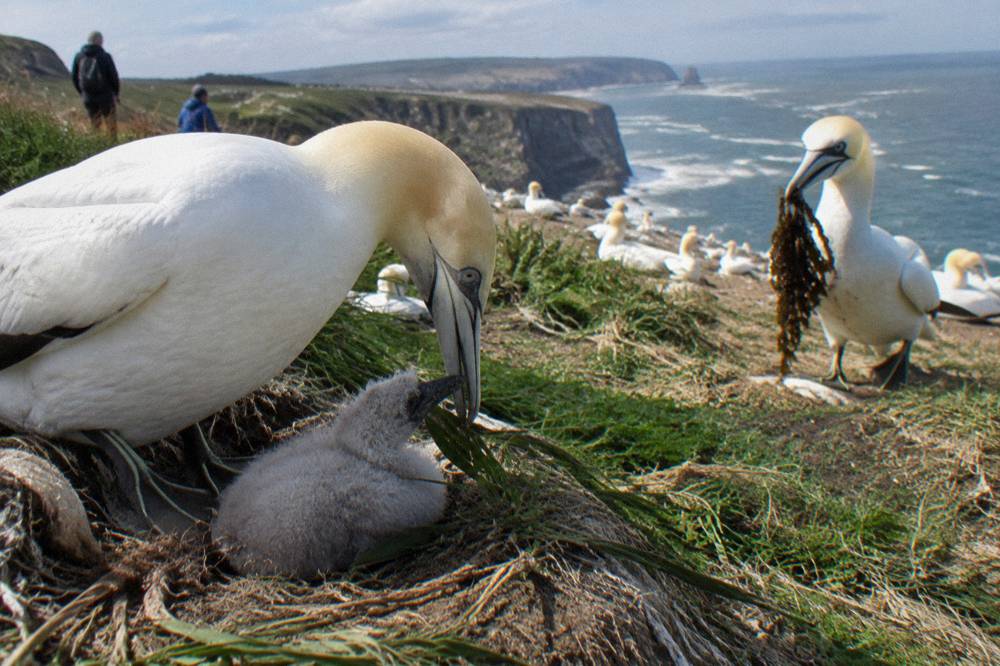
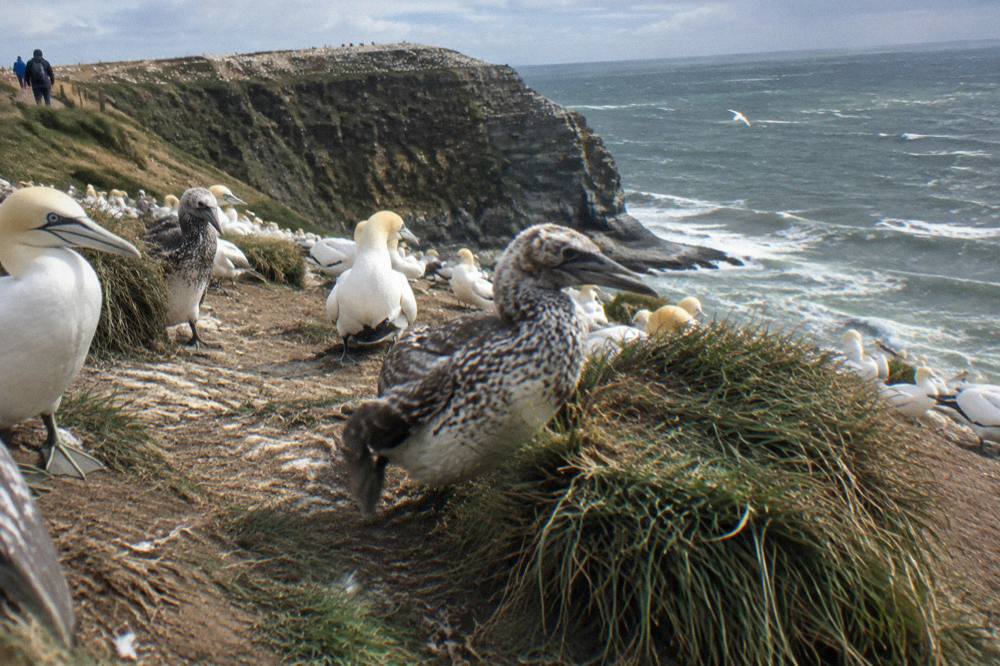
By March and April the chicks have grown into larger grey-brown juveniles visible at the colony as they approach fledging. Fledglings make a Tasman Sea crossing of about 2,800 km to Australia and typically return in their third year. Adults, by contrast, wear the crisp white-and-black adult dress.
The egg-and-feet detail is worth knowing before you visit, because it changes what you see. There are no deep nests hiding the eggs here: an incubating gannet sits its egg on top of its feet, folded over it. Scan the colony from the viewing area and you can often tell incubating birds from resting ones by posture alone.
| Stage | Appearance | Where it sits in the season |
|---|---|---|
| Egg | Single egg, incubated on a parent's webbed feet | Laying follows the July return and nest building |
| Downy chick | Grey-white down, tucked close to a parent | Within DOC's best viewing window |
| Juvenile | Speckled grey-brown plumage, scruffy next to adults | Later in the viewing window and into autumn |
| Fledgling departure | Brown immature bird leaving for Australia | Ahead of the season's close on 30 April |
| Adult | White with black wingtips, wingspan about 1.8 m | Present from around July |
By March and April the chicks are growing toward fledging, and larger grey-brown juveniles are visible at the colony while the adults are increasingly absent. That scruff is the stage most photographers want, and the gannet photography guide goes into how to work the light and the angles from the plateau. Adults, for reference, carry a wingspan of about 1.8 m and can live 25 to 40 years, which is why pair bonds and nest sites matter so much to them.
The life story is remarkable even by seabird standards. The last chicks depart the colony during May, and the plateau stays quiet until nesting begins again in mid-September. Standing at the plateau watching a speckled juvenile exercise its wings, you are watching the dress rehearsal for one of the longer commutes in the bird world.
Do Gannets Mate For Life At Cape Kidnappers?
Yes, adults return from around July, and DOC puts the start of nesting at mid-September. Pairs stay together across seasons, which is why the early-season colony looks so theatrical: familiar partners re-performing greeting displays, rebuilding nests and defending their patch of plateau.
Pair fidelity shapes the whole calendar. Because partners know each other, the early-season colony is less a courtship free-for-all and more a reunion, with fencing bills, bowing and sky-pointing displays concentrated in the weeks after arrival. Nesting gannets dislike loud noise and fast movement, and visitors are asked to keep behind barriers or at least five metres from nesting birds, so the displays are watched rather than interrupted.
A nesting group like this has its own name, which trips up plenty of quiz nights: a colony is also called a gannetry. The term matters here because Cape Kidnappers is not one homogeneous mass but linked nesting sites, with Black Reef the first nesting site on the walking route, 7.5 km from Clifton, and the plateau colony beyond it on private land, reached by the steep climb or by the overland tour. The full story is in what a group of gannets is called.
Can You See Gannet Chicks From The Overland Tour?
Yes. The overland tours finish at the plateau colony, which DOC calls the best place to view nesting gannets, and the operator says everything can be seen from the vehicle without getting out if you prefer. The plateau is flat ground with bench seats, so watching chicks is a seated, low-effort affair rather than a hike.
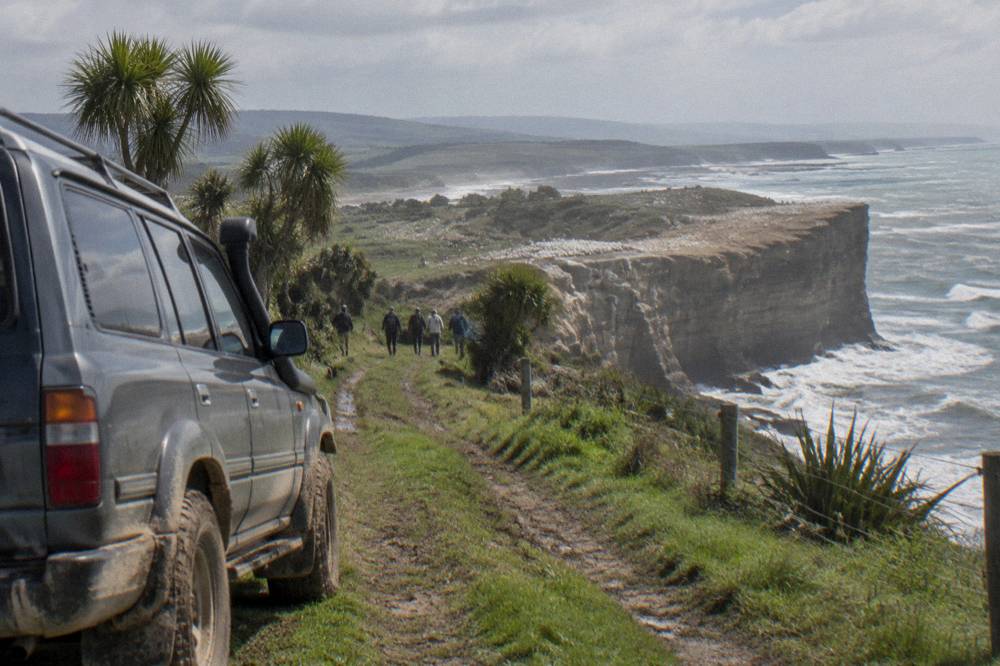
This is the point that decides the trip for many families and older travellers. The operator describes walking at the plateau as safe and easy, with little or no walking required; a guest only needs to be able to get on and off the vehicle unaided. The route itself is a 4WD ride across a working farm of roughly 2,500 hectares and native bush to a privately owned nature reserve above the cliffs, and the operator says the tours are not governed by the tides because they travel above the cliff tops. More of these guides are collected on Napier Gannet Tour.
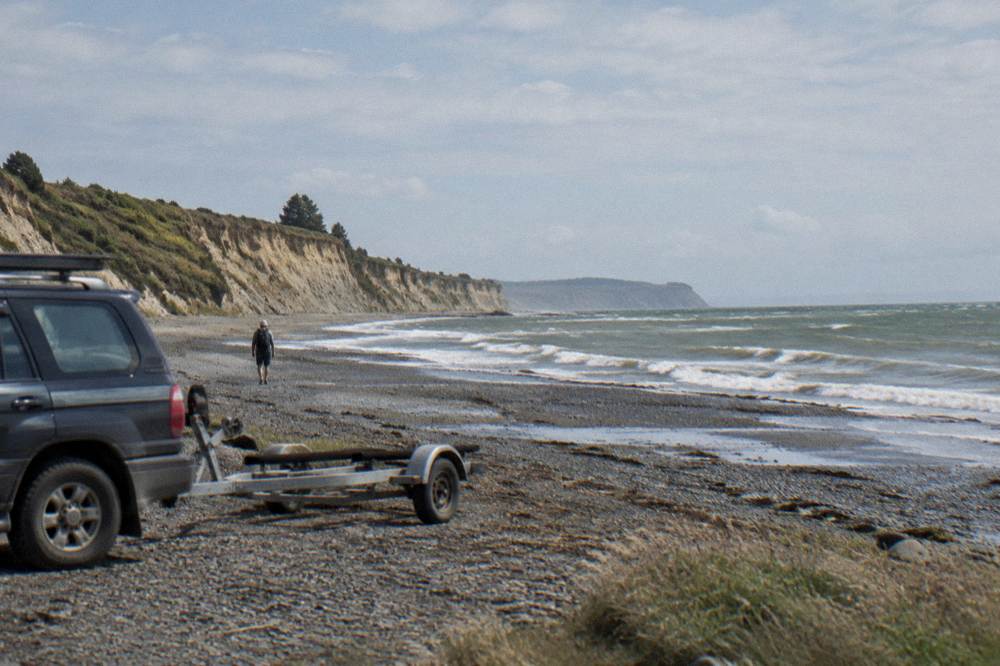
The contrast with the alternatives is stark. The beach walk from Clifton is 19 km return, graded Expert, with DOC advising at least 5 hours for a comfortable return, possible only around low tide, and about 7 km of it runs beneath cliffs subject to significant landslide hazard. A landslide seriously injured two tourists in January 2019 and a large landslide in February 2020 closed the beach before the track reopened. DOC says the track's status can change at any time and to check the safety alert on its page. The Cape Kidnappers walk guide covers that route in full for readers who want it.
Two comfort facts finish the picture. There are no toilets on the tour itself; the last toilets are at the operator's base at 396 Clifton Road, Te Awanga, which has good bathroom facilities and a large off-road car park with room for several motorhomes. Tea, coffee and a biscuit are served at the colony. Dogs are not allowed anywhere in the reserve, it being a wildlife sanctuary and DOC reserve.
How Does Tour Timing Line Up With The Chick Stage?
The tour season, 1 August to 30 April, comfortably wraps around the best viewing window of early November to late February, so any tour booked inside that window can deliver chick stages. The choice is really about format and price, from the 3-Hour Tour, Meet at Base from $56.23 per person to the Private 4-Hour Tour from $704.30 per group of up to 4.
Start with the two shared 3-hour options, because they carry the review history. The 3-Hour Tour, Meet at Base runs from $56.23 per person, rated 4.9 across 1,052 reviews, starting at 396 Clifton Road, Te Awanga, with hotel pickup available as an optional add-on chosen at booking. The 3-Hour Tour, Lowest Price runs from $55.00 per person, rated 4.8 across 378 reviews, and meets at the operator's Te Awanga base; light refreshments are included, hotel pickup and drop-off are not. Between the two, the $55 fare is the cheaper headline price and it meets at the base, while the $56.23 tour carries the deeper review pool and offers hotel pickup as an optional add-on; both include refreshments and both allow free cancellation up to 24 hours before start.
Neither of those 3-hour tours is for cruise passengers; only the shore excursions are. Cruise visitors should read the Napier shore excursion guide for the port logistics: the ships visit from October to April, passengers cannot walk out of the port, and a shuttle runs to the Napier i-SITE and the National Aquarium.
The private formats are priced per group, up to 4 people, so they should never be compared head-on with per-person fares. What they buy is control of the clock, which matters to photographers chasing particular light at a particular stage of the season.
| Tour | Format | Price from | Duration | Best for chick-season timing |
|---|---|---|---|---|
| 3-Hour Tour, Meet at Base | Shared, per person | $56.23 | 3 hours | The proven default inside the viewing window |
| 3-Hour Tour, Lowest Price | Shared, per person | $55.00 | 3 hours | Travellers staying in Napier without a car |
| 4-Hour Shore Excursion, 45-Minute Stop | Shared, per person, cruise only | $95.42 | 4 hours, 45 minutes at the colony | Cruise days between October and April |
| Private 4-Hour Tour | Private, per group up to 4 | $704.30 | 4 hours, 45 minutes at the colony | Photographers and families wanting their own pace |
What If Your Trip Falls Outside The Best Viewing Window?
A visit between August and October still shows a working colony: adults back from July, courtship displays, nest building and incubation, all with fewer visitors on the vehicle. A March or April visit trades chick numbers for late-summer light and thinning crowds. The only genuinely dead months are May to July, before the tours resume.
Spring at the cape is underrated. You will not see many chicks, but you will see the behaviour that produces them, which many observers find just as compelling. The what to wear guide matters more in these shoulder months, when a water and windproof jacket and extra layers for cool sea breezes earn their place in your day pack.
March and April suit travellers whose trips are fixed by school holidays or work calendars rather than by birds. The best viewing window closes in late February, so a trip in these months falls just outside it. The colony is a gentler, quieter place by then. The drive from Napier to the base at 396 Clifton Road, Te Awanga takes about 25 minutes in any month.
Which Tour Should You Book For Chick Season?
For most readers timing a chick-stage visit, the standard 3-hour overland tour is the right call: from $55 per person meeting at the base in Te Awanga or $56.23 per person with hotel pickup as an optional extra, rated 4.8 and 4.9, with hundreds of reviews between them. Choose the private 4-hour format from $704.30 per group if you want the plateau at your own pace, and the shore excursion if you arrive by ship.
The decision usually comes down to transport and party size. If you have a rental car or motorhome, the meet-at-base version at 396 Clifton Road works simply, and the base's off-road car park accommodates motorhomes. If you are staying in Napier without a car, 3-Hour Tour, Meet at Base (from $56.23) offers an optional hotel pickup add-on at booking, which covers the 25 minute drive to the base. Families weighing the choice can also read the tour with kids guide, and the fitness guide confirms how little walking is involved.
Cruise passengers have exactly two eligible options. The 4-Hour Shore Excursion, 45-Minute Stop runs from $95.42 per person, meets at 100 Marine Parade opposite the Napier Museum, about 200 m from where the cruise shuttle drops at the Napier i-SITE, and spends 45 minutes at the colony per its itinerary. The 4WD Safari Vehicle version runs from $93.00 per person, about 25 minutes each way by coach from the same Marine Parade meeting area. Check your ship's all-aboard time against the 4-hour length before booking either.
What Should You Know Before Booking A Chick-Season Tour?
Book inside the early-November-to-late-February window if chick stages are the priority, arrive with realistic expectations because no stage is guaranteed on a given day, and use the free cancellation that applies up to 24 hours before start on every tour covered here. Weather can delay or reschedule a departure, so keep one flex day in a tightly planned trip.
A few practicalities close the loop. The base at 396 Clifton Road, Te Awanga sits about a 25 minute drive from Napier, and the same from Hastings and Havelock North, so the tour pairs naturally with a wider Hawke's Bay day. The area is susceptible to tsunami; a siren or alert means move to higher ground. Drones need a DOC permit on conservation land, so leave them behind unless you have arranged one. Refreshments are modest across the shared tours, coffee or tea and light refreshments, and the private sunrise formats go further, one including a gourmet breakfast of pastries, fresh fruit and yoghurt with plunger coffee and juice.
The budget picture, for readers who want it plainly: among the two shared 3-hour tours with real review pools, the $55.00 per person option from 378 reviews is the cheaper entry and meets at the base at Te Awanga, while the dearer one at $56.23 per person from 1,052 reviews also meets there but sells hotel pickup as an optional add-on, a difference of barely a dollar. The full price breakdown, including how the per-group private formats really compare, is in the gannet tour price guide.
How Do You Plan The Whole Gannet Day?
Anchor the day on the tour time, build the drive around it, and treat the rest of Hawke's Bay as the bonus. The base is about 25 minutes from Napier, the shared tours run about 3 hours, and the shore excursions run about 4 hours door to door from Marine Parade, so a morning tour still leaves an afternoon for the wineries, Te Mata Peak or Napier's Art Deco quarter.
Readers assembling a full itinerary will find the pieces in the what to do at Cape Kidnappers and one day in Napier guides, and the where to stay in Napier page matches accommodation areas to the pickup options. The through-line of every version is the same: book the month inside the viewing window, book the format that fits your party, and let the colony supply the spectacle.
Common Questions About Gannet Chicks At Cape Kidnappers
When Do Gannet Chicks Hatch At Cape Kidnappers?
Hatch timing shifts from season to season, so no single week can be promised. DOC names early November to late February as the best viewing window, and chick and juvenile stages fall within it, but no stage can be promised on any given day.
When Is The Gannet Season At Cape Kidnappers?
Adults return from around July, the overland tours run 1 August to 30 April including Christmas Day, and DOC's best viewing window is early November to late February.
Do Gannets Mate For Life?
Yes, pairs stay together over many seasons and reunite at the same nest site each year, with courtship and nest building from around July.
Can You See Gannet Chicks From The Overland Tour?
Yes. The tours reach the plateau colony, which DOC calls the best place to view nesting gannets, and the operator says everything can be seen from the vehicle, with the plateau flat and equipped with bench seats.
Which Tour Should You Book For Chick Season?
For most travellers the standard 3-hour tour is the right choice, from $55.00 per person meeting at the base at 396 Clifton Road, Te Awanga, or $56.23 per person with hotel pickup as an optional add-on at booking. Cruise passengers have their own 4-hour shore excursion from $95.42 per person.
When Do Young Gannets Fly To Australia?
Fledglings make their first flight not around the bay but across roughly 2,800 km of open Tasman Sea to Australia, a crossing they make alone. They typically return to Cape Kidnappers in their third year, to the colony where they were raised.